
Intrinsically Safe (Ex i) vs Explosion-Proof (Ex d):
Differences, Applications, Advantages and Selection Guide
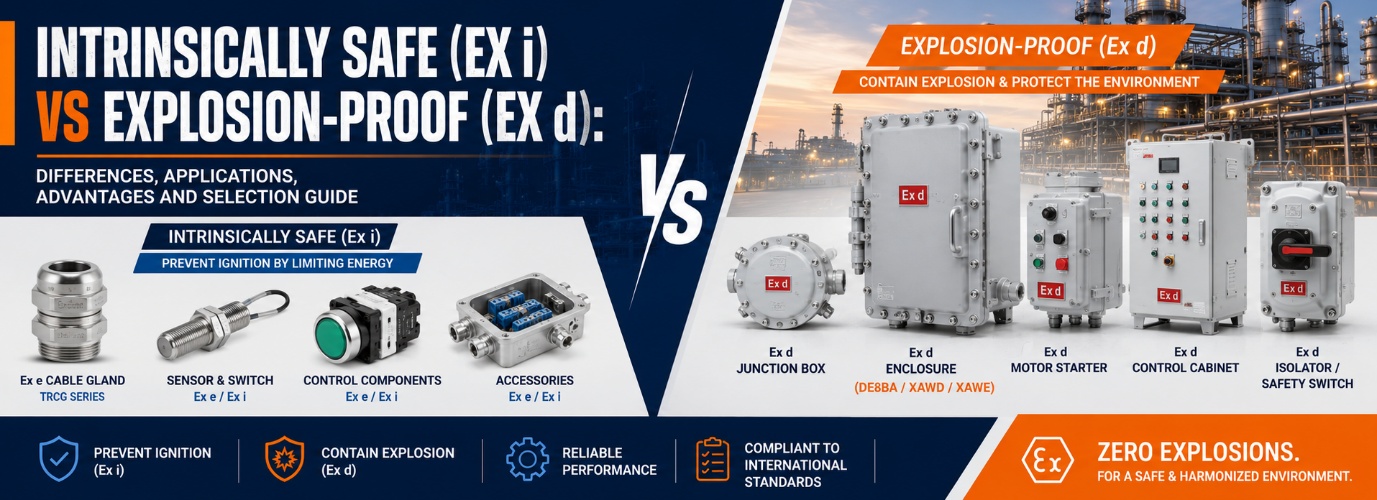
Electrical equipment operating in hazardous areas must be designed to prevent explosions, but not all explosion protection methods work the same way. Two of the most widely used protection concepts are Intrinsically Safe (Ex i) systems and Explosion-Proof (Ex d) enclosures. Although both are designed to minimise ignition risks in explosive atmospheres, they follow fundamentally different engineering philosophies.
Intrinsically safe systems prevent an explosion by limiting electrical energy so that ignition cannot occur. Explosion-proof enclosures, on the other hand, assume an internal ignition may happen and are specifically engineered to contain the explosion safely without allowing flames to escape into the surrounding hazardous atmosphere.
Understanding the differences between these two protection concepts is essential for engineers, plant operators, project managers, procurement teams, and anyone responsible for specifying electrical equipment in hazardous locations. Choosing the right solution affects not only safety and regulatory compliance but also installation costs, maintenance requirements, operational flexibility, and long-term reliability.
Not sure which protection method is right for your application?
ISEP specialises in hazardous area engineering solutions, helping clients select certified explosion protection systems that comply with IECEx, ATEX, and other international standards. Whether you're designing a new facility or upgrading an existing installation, our engineers can help identify the most suitable solution.
Quick Answer: Intrinsically Safe vs Explosion-Proof
If you're looking for a quick comparison:
- Intrinsically Safe (Ex i) systems prevent ignition by limiting electrical and thermal energy below the level required to ignite hazardous gases or dust.
- Explosion-Proof (Ex d) equipment allows an internal explosion to occur but safely contains it within a robust enclosure, preventing flames or hot gases from igniting the surrounding atmosphere.
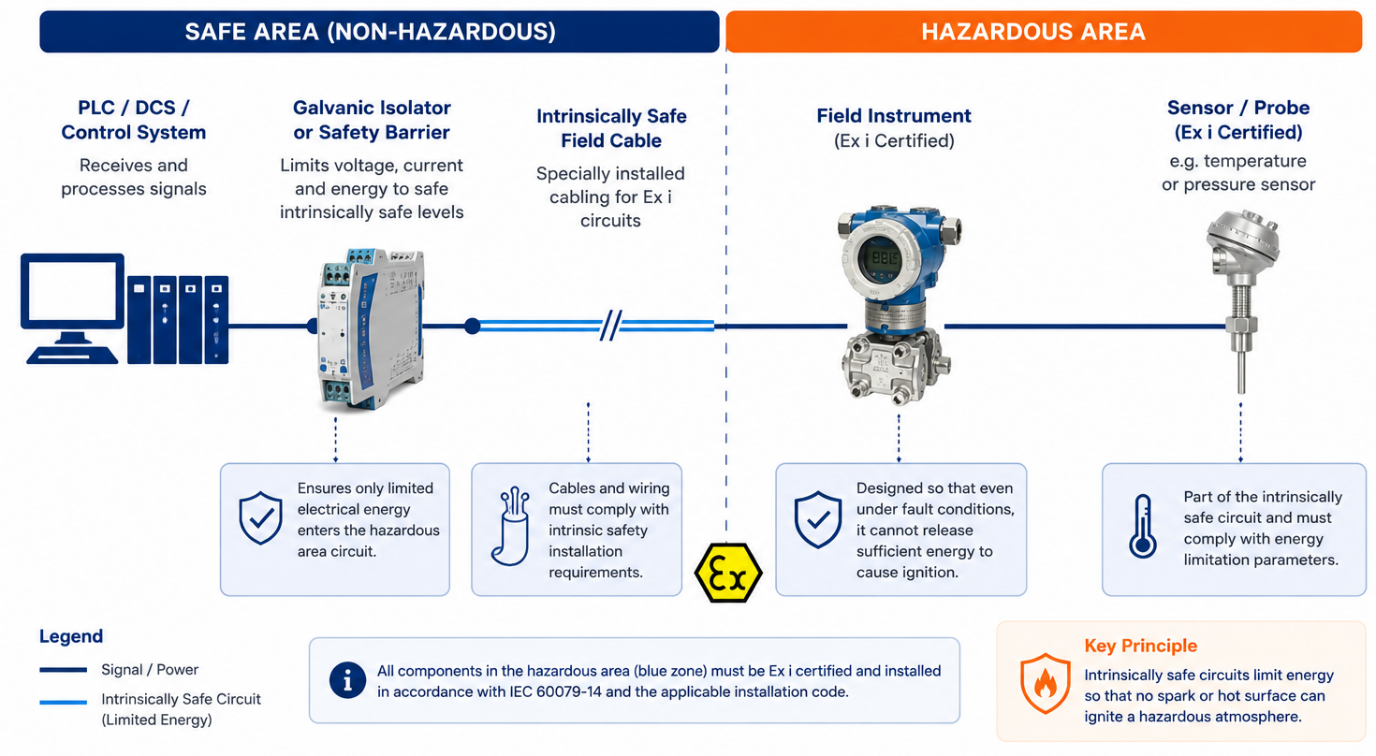
In general:
- Choose Intrinsic Safety for low-power instrumentation and sensors.
- Choose Explosion-Proof for motors, lighting, control panels, junction boxes, and other higher-power equipment.
Although they may seem like competing technologies, both protection concepts are commonly used together within the same industrial facility.
What Are Hazardous Areas?
Before comparing Ex i and Ex d, it's helpful to understand why explosion protection is necessary.
A hazardous area is any location where flammable gases, vapours, combustible dusts, or ignitable fibres may be present in sufficient concentrations to create an explosive atmosphere. Under these conditions, even a small spark or hot surface from electrical equipment can become an ignition source.
Common hazardous environments include:
- Oil and gas processing facilities
- Petrochemical plants
- Offshore platforms and FPSOs
- LNG and FLNG facilities
- Chemical manufacturing plants
- Pharmaceutical production facilities
- Grain silos and flour mills
- Wastewater treatment plants
- Paint and coating facilities
These locations are typically classified according to internationally recognised hazardous area standards, such as IECEx, ATEX, or NEC Class/Division, to ensure that appropriate explosion protection methods are selected.
Understanding the Two Engineering Philosophies
One of the biggest misconceptions is that intrinsically safe and explosion-proof equipment achieve safety in the same way. In reality, their design philosophies are almost opposite.
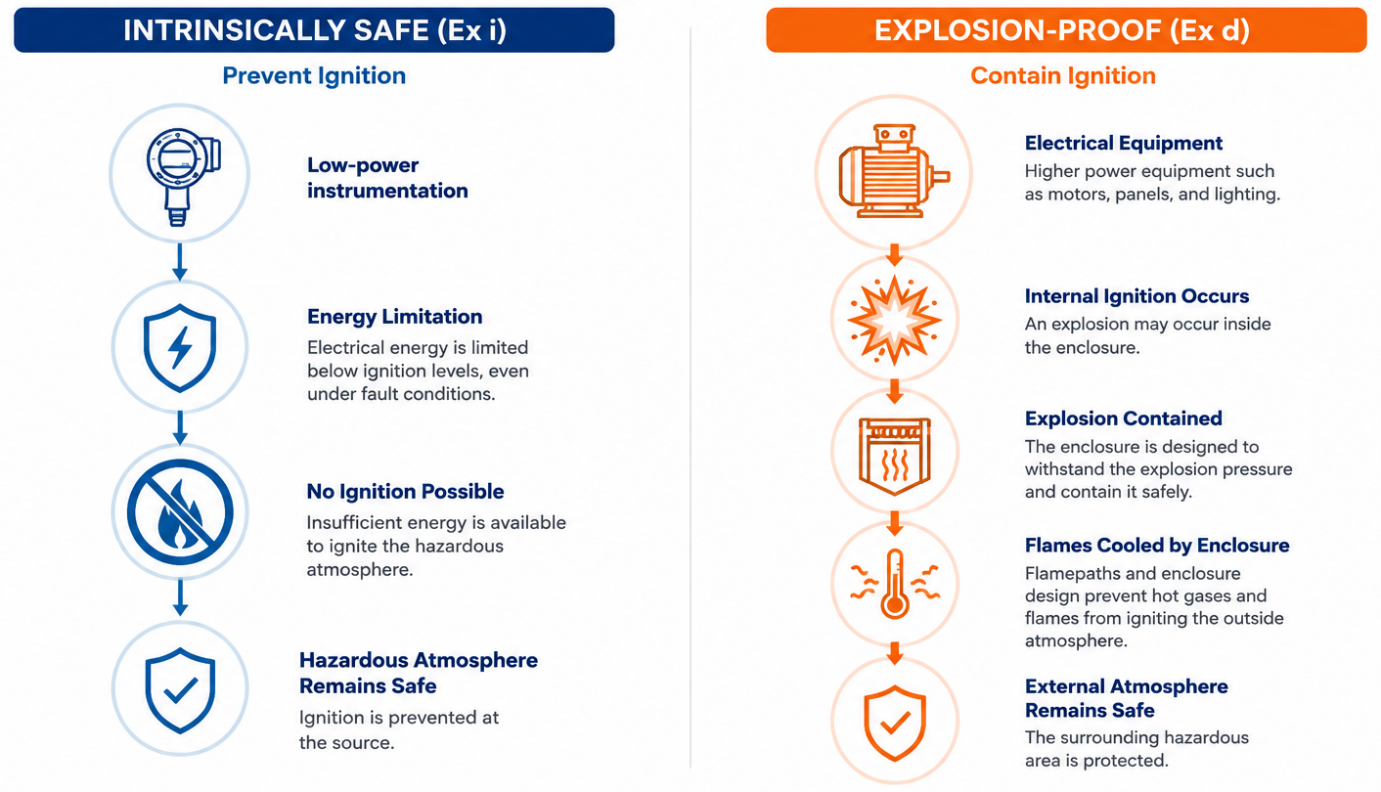
Intrinsically Safe (Ex i): Prevent the Ignition
Intrinsic safety focuses on preventing ignition from occurring in the first place. Electrical circuits are carefully designed so that, even under normal operation or specified fault conditions, they cannot release enough electrical or thermal energy to ignite the surrounding hazardous atmosphere.
Rather than relying on heavy mechanical construction, intrinsic safety depends on precise electrical design, current limitation, voltage limitation, and energy control.
In simple terms, no dangerous spark is ever allowed to occur.
Explosion-Proof (Ex d): Contain the Explosion
Explosion-proof equipment follows a completely different philosophy. Instead of preventing ignition, it assumes that an explosion may occur inside the enclosure due to electrical arcs, sparks, or hot components.
The enclosure is engineered to:
- Withstand the pressure generated by an internal explosion.
- Prevent flames from escaping.
- Cool any escaping gases through specially designed flamepaths so they cannot ignite the surrounding atmosphere.
Rather than preventing ignition, explosion-proof equipment prevents an internal explosion from becoming an external one.
Intrinsically Safe vs Explosion-Proof: Key Differences
| Feature | Intrinsically Safe (Ex i) | Explosion-Proof (Ex d) |
|---|---|---|
| Primary protection method | Prevents ignition | Contains ignition |
| Electrical power | Low | High |
| Typical equipment | Sensors, transmitters, portable devices | Motors, lighting, control panels |
| Equipment size | Compact | Larger and heavier |
| Maintenance | Often possible while energised | Usually requires shutdown |
| Installation | Simpler field devices | Heavy-duty mechanical installation |
| Zone suitability | Zone 0, 1 and 2 (depending on certification) | Primarily Zone 1 and Zone 2 |
| Typical enclosure | Lightweight | Heavy cast metal |
Typical Applications
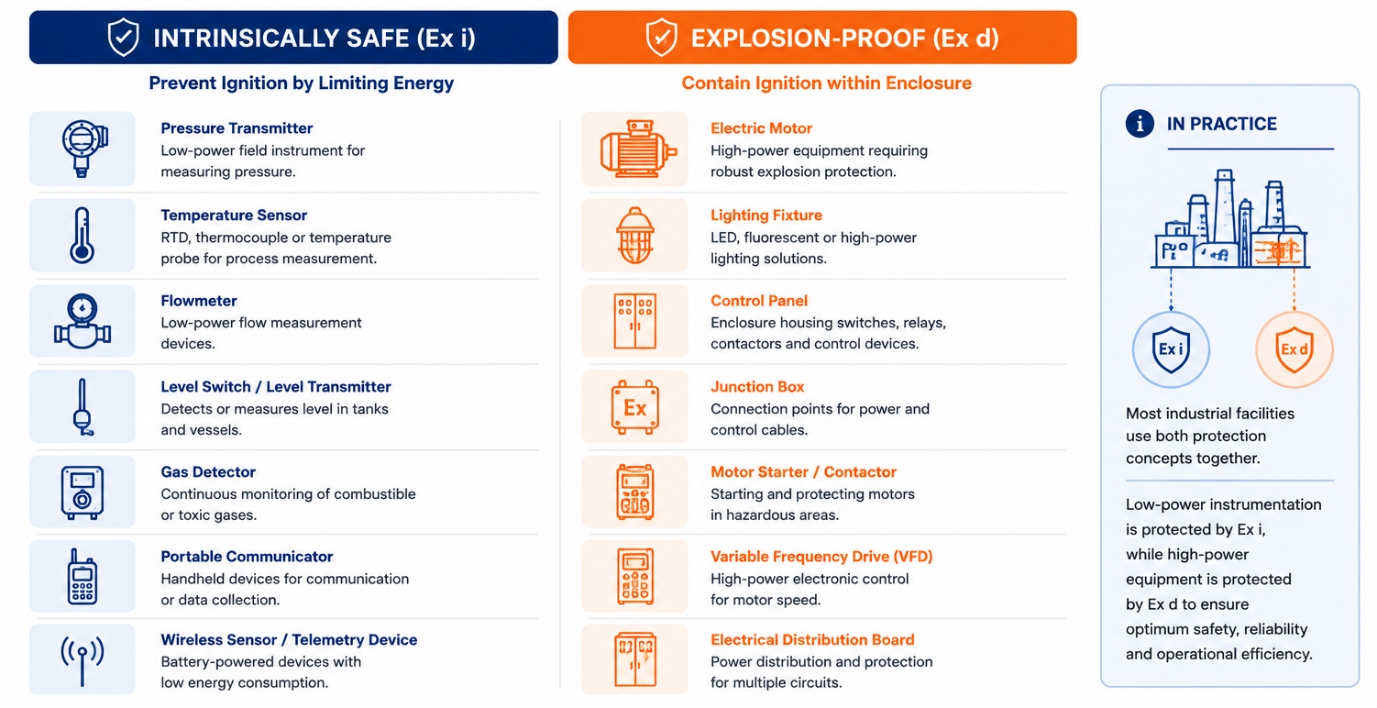
Common Applications for Intrinsically Safe Systems
Intrinsic safety is particularly suitable for low-power instrumentation, including:
- Pressure transmitters
- Temperature sensors
- Flow meters
- Level switches
- Gas detectors
- Portable inspection equipment
- Wireless instrumentation
- Process control loops
These devices require relatively little electrical power, making intrinsic safety both practical and cost-effective.
Common Applications for Explosion-Proof Equipment
Explosion-proof equipment is typically selected where higher electrical power is required, including:
- Explosion-proof control panels
- Junction boxes
- Electric motors
- LED lighting fixtures
- Distribution boards
- Motor starters
- Variable frequency drives (VFDs)
- Local operator stations
Because these applications involve significantly higher electrical energy, intrinsic safety alone is generally not feasible.
Advantages and Limitations of Each Protection Method
Advantages of Intrinsically Safe Systems
- Prevents ignition rather than containing explosions.
- Lightweight and compact equipment.
- Lower installation costs for instrumentation.
- Simplified maintenance.
- Many devices can be serviced while energised.
- Ideal for continuous process industries.
Advantages of Explosion-Proof Enclosures
- Supports high-power electrical equipment.
- Extremely robust construction.
- Excellent mechanical durability.
- Suitable for complete electrical assemblies.
- Long service life in harsh industrial environments.
Limitations of Each Protection Method
While both systems offer proven explosion protection, each has specific limitations depending on the application:
Intrinsically Safe (Ex i) Limitations: Restricted to low-power applications (typically under 30V and 100mA), requires strict cable and loop calculations, and requires barriers or isolators in the safe area.
Explosion-Proof (Ex d) Limitations: Heavy and bulky construction increases structural load and transport costs, installation requires heavy conduit or certified flameproof cable glands, and opening enclosures for maintenance requires de-energising the equipment (hot work permit required).
Can Intrinsically Safe and Explosion-Proof Systems Be Used Together?
Absolutely.
In fact, many modern hazardous area facilities combine multiple explosion protection concepts.
For example:
- Pressure transmitters may utilise intrinsic safety.
- PLC control panels may be explosion-proof.
- Hazardous area lighting may be flameproof.
- Motors may use explosion-proof housings.
- Sensors may communicate through intrinsically safe barriers.
Rather than competing solutions, Ex i and Ex d frequently complement each other.
Intrinsically Safe vs Explosion-Proof: Which Should You Choose?
The choice between an Intrinsically Safe (Ex i) system and an Explosion-Proof (Ex d) enclosure depends on the application, hazardous area classification, power requirements, and maintenance strategy. Neither protection method is universally better; each is designed to address different operational needs.
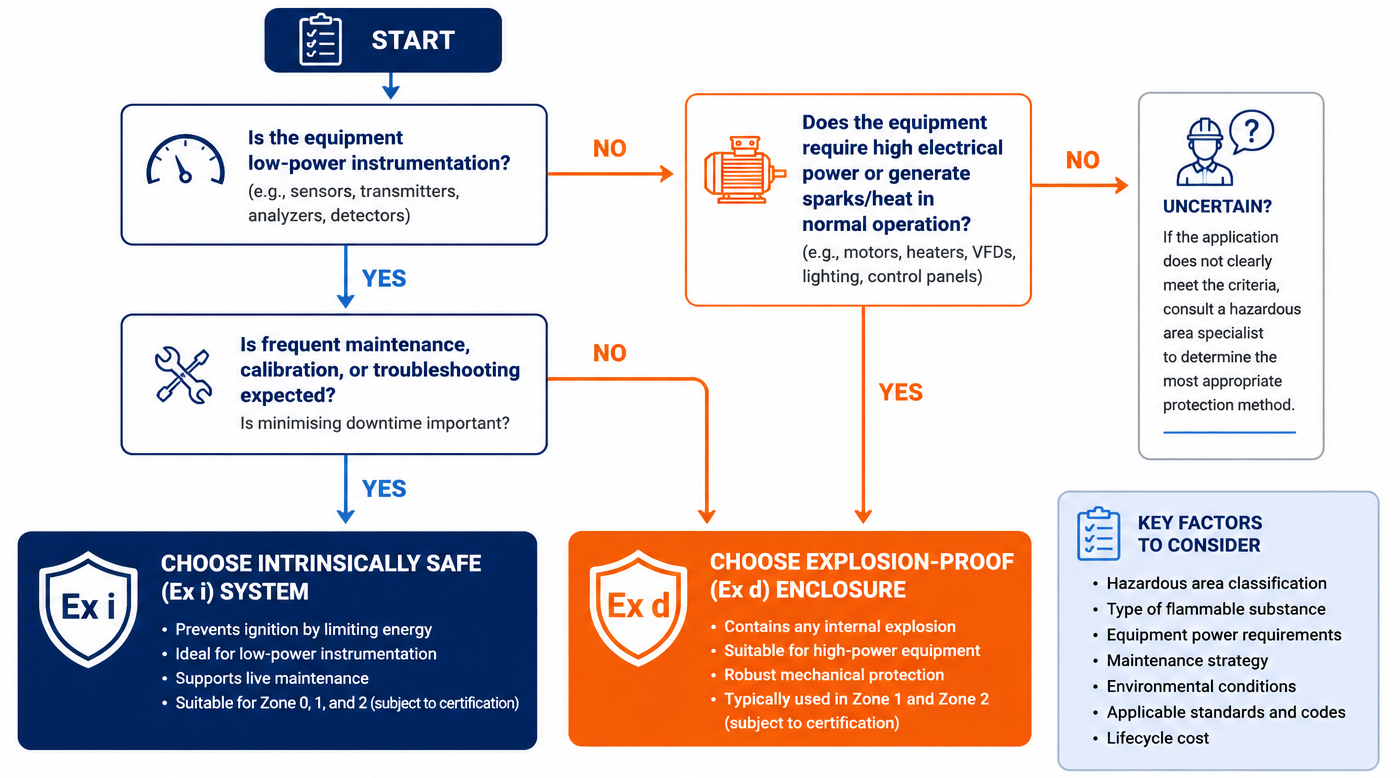
Choose an Intrinsically Safe (Ex i) System When:
- The application involves low-power instrumentation such as sensors, transmitters, or measuring devices.
- Frequent maintenance, calibration, or troubleshooting is expected.
- Minimising operational downtime is important, as many intrinsically safe devices can be serviced without shutting down the process.
- The installation is located in a Zone 0 hazardous area or another environment requiring the highest level of ignition prevention (subject to the appropriate certification).
- Compact, lightweight equipment and simplified field installation are preferred.
Choose an Explosion-Proof (Ex d) Enclosure When:
- The application requires high-power electrical equipment such as motors, heaters, or variable frequency drives (VFDs).
- Explosion-proof control panels, junction boxes, or lighting fixtures are being installed in hazardous locations.
- The equipment must withstand harsh industrial environments and provide robust mechanical protection.
- Electrical components generate sparks, arcs, or high operating temperatures during normal operation.
- A heavy-duty enclosure is required to safely contain any internal explosion and prevent it from igniting the surrounding atmosphere.
Key Takeaways
- Intrinsically safe systems prevent ignition by limiting electrical energy.
- Explosion-proof equipment safely contains internal explosions.
- Ex i is ideal for instrumentation.
- Ex d is ideal for higher-power equipment.
- Many hazardous area installations use both protection methods together.
- Proper hazardous area classification and certified equipment selection are essential for regulatory compliance and operational safety.
General recommendations for selecting Intrinsically Safe (Ex i) or Explosion-Proof (Ex d) protection based on common industrial applications (IEC, 2014).
| Application | Preferred Protection Method | Typical Reason |
|---|---|---|
| Pressure transmitter | Ex i | Low energy instrumentation |
| Temperature sensor | Ex i | Live maintenance capability |
| Gas detector | Ex i | Continuous monitoring |
| Portable handheld device | Ex i | User safety |
| Motor | Ex d | High electrical power |
| LED lighting | Ex d | High power and heat |
| Control panel | Ex d | Multiple electrical components |
| Junction box | Ex d | Electrical connections |
| Variable Frequency Drive (VFD) | Ex d | High-power switching |
Conclusion
Intrinsically safe systems and explosion-proof enclosures each play an essential role in hazardous area engineering. While one prevents ignition through energy limitation and the other contains internal explosions through robust mechanical design, both contribute to protecting personnel, equipment, and facilities operating in potentially explosive atmospheres.
Rather than asking which protection method is better, the more important question is which method is most appropriate for the specific application. Factors such as hazardous area classification, equipment power requirements, maintenance strategy, and regulatory compliance all influence the final selection.
By understanding the strengths and limitations of each approach, organisations can implement safer, more reliable, and more cost-effective hazardous area installations that meet international standards while supporting long-term operational performance.
ISEP provides comprehensive hazardous area engineering services, including technical consultation, equipment selection, system integration, and certified explosion-proof solutions for industries operating in challenging environments. Whether you are evaluating Intrinsically Safe (Ex i) systems, Explosion-Proof (Ex d) enclosures, or a combination of both, our experienced engineers can help identify the safest and most practical solution for your facility.
Contact Us Today
Speak with our certified specialists to select, design, or verify hazardous area protection systems customized for your facility requirements.
Frequently Asked Questions (FAQ)
The primary difference lies in how each protection method prevents explosions. An Intrinsically Safe (Ex i) system limits electrical and thermal energy so that ignition cannot occur, even under specified fault conditions. In contrast, an Explosion-Proof (Ex d) enclosure is designed to safely contain an internal explosion and prevent flames or hot gases from igniting the surrounding hazardous atmosphere. Intrinsically safe systems are commonly used for low-power instrumentation, while explosion-proof enclosures are typically used for higher-power equipment such as motors, lighting, and control panels.
Neither protection method is inherently better. The most suitable option depends on the application, hazardous area classification, equipment power requirements, and maintenance needs. Intrinsically safe systems are ideal for low-power devices and applications requiring frequent maintenance, while explosion-proof enclosures are better suited for high-power electrical equipment that cannot operate under intrinsic safety limitations.
Yes. Many industrial facilities use both protection concepts within the same hazardous area. For example, field instruments such as pressure transmitters may be connected through intrinsically safe circuits, while nearby control panels, junction boxes, and lighting fixtures are protected using explosion-proof enclosures. Combining different protection methods allows engineers to optimise safety, functionality, and cost.
Intrinsically safe systems are widely used in hazardous areas where low-power instrumentation is required. Typical applications include pressure transmitters, temperature sensors, flow meters, level switches, gas detectors, portable communication devices, and process control instrumentation in industries such as oil and gas, petrochemicals, pharmaceuticals, mining, and wastewater treatment.
Explosion-proof enclosures are commonly used for equipment that operates at higher electrical power levels or generates sparks, arcs, or heat during normal operation. Examples include electric motors, control panels, junction boxes, LED lighting fixtures, motor starters, disconnect switches, variable frequency drives (VFDs), and industrial electrical distribution equipment installed in hazardous areas.
Generally, no. Standard Explosion-Proof (Ex d) equipment is typically certified for Zone 1 and Zone 2 hazardous areas. For Zone 0, where explosive atmospheres are present continuously or for long periods, Intrinsically Safe (Ex ia) systems are usually the preferred protection method because they are specifically designed to prevent ignition even under multiple fault conditions. Equipment selection should always be based on the applicable certification and hazardous area classification.
Hazardous area equipment is commonly certified to internationally recognised standards such as the IEC 60079 series and the IECEx Certification Scheme. In Europe, equipment must also comply with the ATEX Directive, while North America primarily follows the National Electrical Code (NEC) and standards published by organisations such as UL and CSA. Selecting equipment certified to the relevant standards is essential for safety and regulatory compliance.
No. Despite the name, explosion-proof equipment is not designed to prevent an internal explosion. Instead, it is engineered to safely contain an explosion within the enclosure and prevent flames or hot gases from igniting the surrounding hazardous atmosphere. This containment principle is what allows explosion-proof equipment to operate safely in hazardous locations.
Because intrinsically safe circuits are designed to limit electrical energy below ignition levels, many maintenance activities such as calibration, testing, or troubleshooting can often be performed without completely de-energising the system. This helps reduce plant downtime and improves operational efficiency, making intrinsically safe systems particularly attractive for continuous process industries.
Engineers evaluate several factors before selecting an explosion protection method, including the hazardous area classification, type of flammable substance present, equipment power requirements, maintenance strategy, environmental conditions, applicable international standards, and overall lifecycle costs. In many cases, the most effective solution combines both intrinsically safe and explosion-proof technologies to provide the highest level of safety and operational performance.