
Explosion-Proof Control Panels Explained:
Complete Guide to Hazardous Area Automation
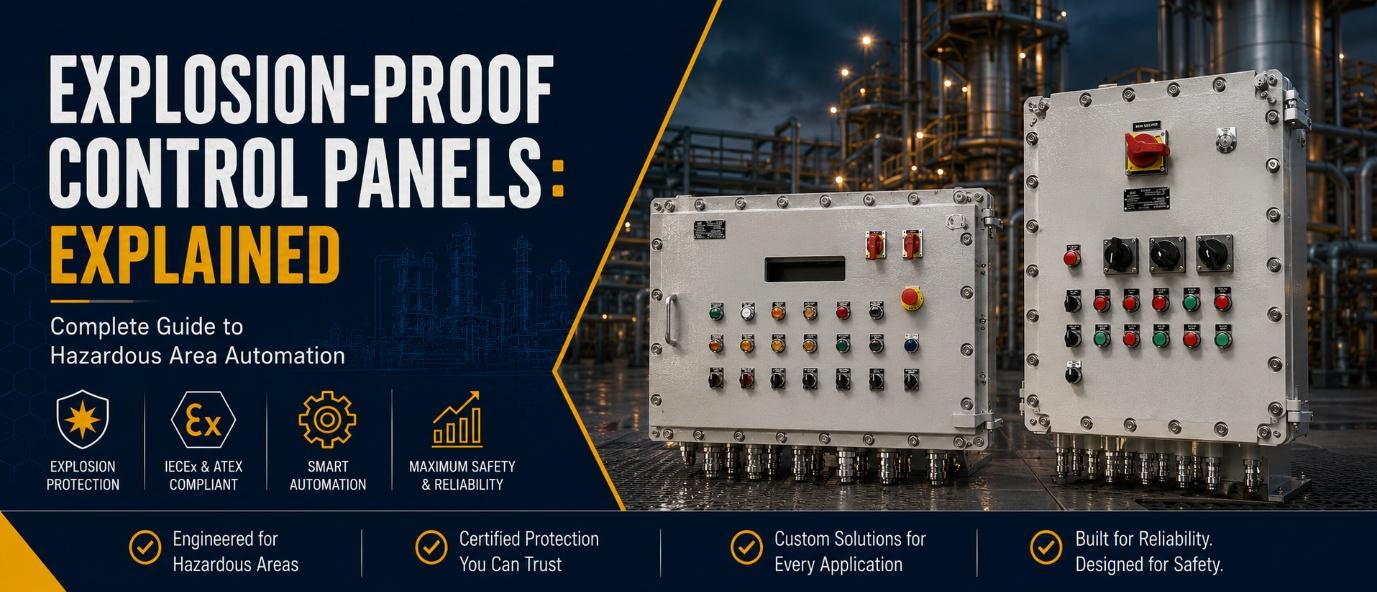
Modern industrial facilities depend heavily on automated control systems. From starting pumps and controlling motors to monitoring process variables and communicating with PLCs, control panels are the brains behind countless industrial operations.
However, when these control systems are installed in hazardous areas containing flammable gases, vapours or combustible dust, ordinary control panels become serious ignition hazards.
This is where an Explosion-Proof Control Panel becomes essential.
Designed specifically for hazardous locations, explosion-proof control panels allow industrial automation to operate safely while complying with international standards such as IECEx, ATEX and NEC.
Need Help Selecting or Designing an Explosion-Proof Control Panel?
ISEP Malaysia provides consultation, engineering, assembly and certified hazardous area solutions tailored to your industry and application.
What Is an Explosion-Proof Control Panel?
An explosion-proof control panel is a specially engineered electrical control system that safely operates electrical equipment inside hazardous environments where explosive atmospheres may be present.
Unlike a standard electrical panel, an explosion-proof control panel incorporates certified protection methods that prevent electrical sparks, excessive temperatures or internal explosions from igniting the surrounding atmosphere.
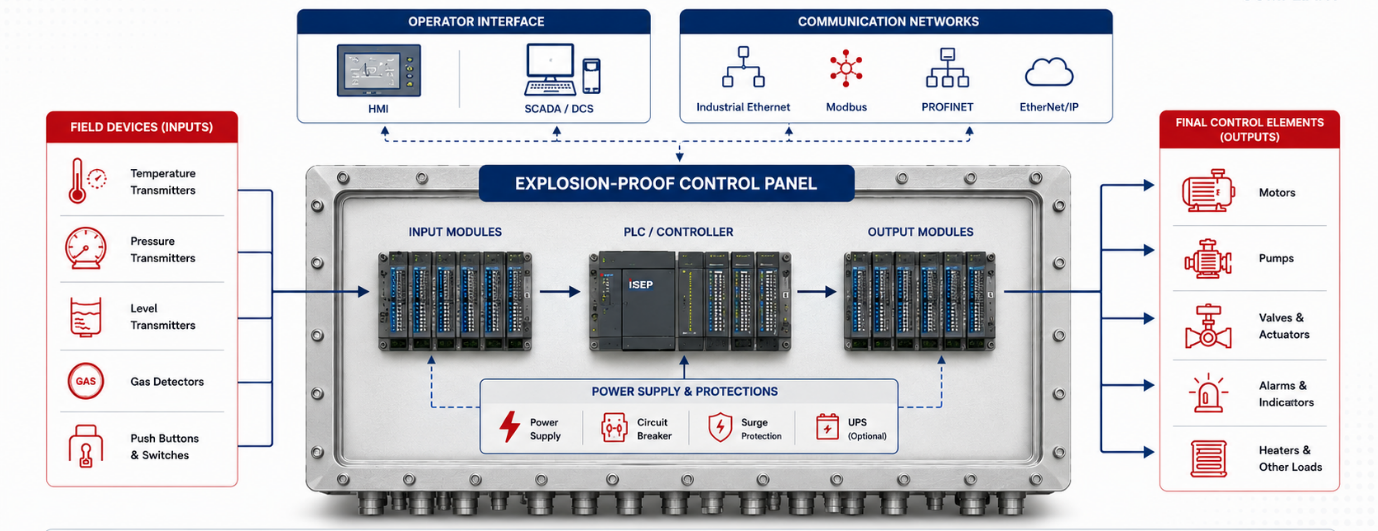
Depending on the application, these panels may contain:
- PLCs (Programmable Logic Controllers)
- Variable Frequency Drives (VFDs)
- Motor starters
- Contactors
- Relays
- Circuit breakers
- Human Machine Interfaces (HMIs)
- Instrumentation interfaces
- Communication equipment
- Power supplies
- Safety interlocks
The exact protection concept depends on the hazardous area classification and the equipment installed.
Explosion-Proof Control Panel vs Explosion-Proof Panel
Although the terms are often used interchangeably, they are not always identical.
| Explosion-Proof Panel | Explosion-Proof Control Panel |
|---|---|
| Focuses on the explosion-proof enclosure or electrical panel | Focuses on the complete automation and control system |
| May function as junction, distribution or terminal panel | Performs monitoring, control and automation functions |
| Often contains passive electrical components | Contains active electrical and electronic control devices |
| Primary role is protection and power distribution | Primary role is controlling industrial processes |
Think of it this way:
The explosion-proof panel is the protective housing.
The control panel is the intelligent system installed inside that housing.
Why Are Explosion-Proof Control Panels Necessary?
Many industrial electrical devices naturally produce:
- Electrical arcs
- Switching sparks
- Heat
- High surface temperatures
- Motor starting currents
In ordinary environments, these pose little concern.
In hazardous locations, however, even a tiny spark can ignite explosive gases or dust clouds, potentially resulting in catastrophic explosions.
Explosion-proof control panels eliminate or contain these ignition sources while allowing equipment to operate safely.
Where Are Explosion-Proof Control Panels Used?
Explosion-proof control panels are commonly installed in industries where combustible substances are routinely present.
Typical applications include:
- Oil & Gas facilities
- Refineries
- Petrochemical plants
- Offshore platforms (FPSO & FLNG)
- Chemical manufacturing
- Pharmaceutical production
- Paint and coating facilities
- Grain processing
- Palm oil mills
- Water and wastewater treatment
- Mining operations
- Hydrogen production facilities
These environments often require continuous automation while maintaining strict hazardous area compliance.
Table showing examples of explosion-proof control panel applications across different hazardous industries (International Electrotechnical Commission, 2021).
| Industry | Typical Equipment Controlled | Main Objective |
|---|---|---|
| Oil & Gas | Pumps, compressors, separators | Process safety |
| Petrochemical | Reactors, mixers | Explosion prevention |
| Offshore FPSO , FLNG, FSO, FSRU | Process skids | Reliable automation |
| Chemical Plants | Dosing systems | Accurate process control |
| Painting / Coating | Process systems | Safe process environment |
| Water Treatment | Pumps, blowers | Continuous operation |
| Palm Oil Mills | Sterilisers, conveyors | Process efficiency |
| Pharmaceutical | HVAC, cleanroom systems | Product quality |
| Hydrogen Plants | Compressors | Safe hydrogen handling |
What Does an Explosion-Proof Control Panel Contain?
Unlike simple distribution boards, explosion-proof control panels integrate multiple automation functions.
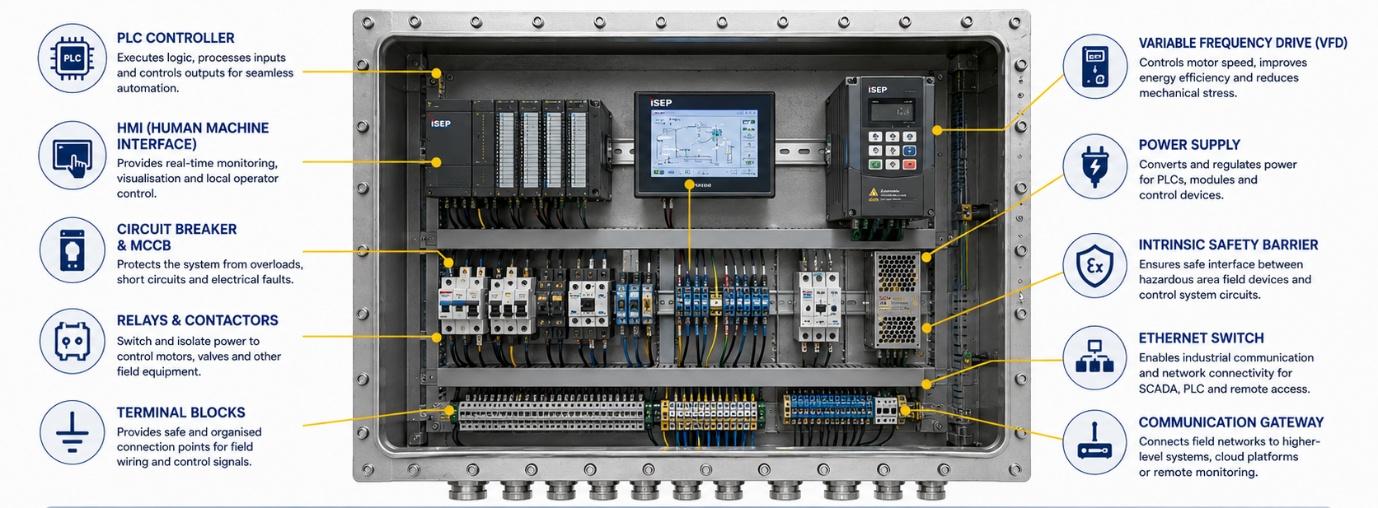
Common components include:
PLC Controllers
PLCs automate industrial processes by receiving inputs from sensors and controlling outputs such as motors, pumps and valves.
Variable Frequency Drives (VFDs)
VFDs regulate motor speed, improve energy efficiency and reduce mechanical stress.
Because VFDs generate considerable heat, thermal management is a critical part of explosion-proof control panel design.
Human Machine Interface (HMI)
HMIs allow operators to monitor equipment status, alarms and operating parameters.
Depending on installation requirements, HMIs may be mounted externally or integrated using certified protection methods.
Motor Starters and Contactors
These safely start, stop and protect electric motors while coordinating with overload protection devices.
Instrumentation Interfaces
Control panels often receive signals from:
- Pressure transmitters
- Temperature sensors
- Flow meters
- Gas detectors
- Level transmitters
These signals enable automated process control and safety monitoring.
Protection Methods Used in Explosion-Proof Control Panels
Not every hazardous area requires the same protection concept.
Engineers select the appropriate method based on the hazardous area classification.
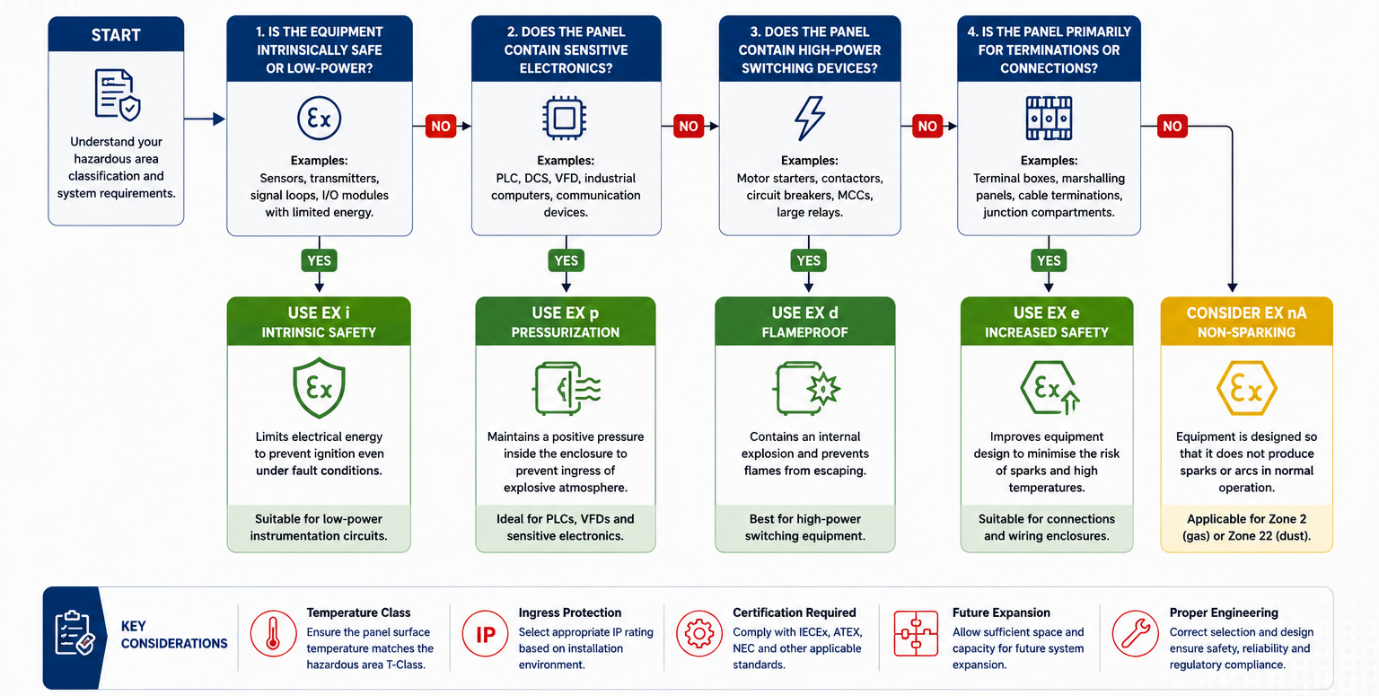
Ex d (Flameproof)
The enclosure is strong enough to contain an internal explosion while preventing flames from escaping.
Suitable for:
- Motor starters
- Contactors
- High-power switching equipment
Ex e (Increased Safety)
Instead of containing explosions, Ex e reduces the likelihood of sparks and excessive temperatures through enhanced construction.
Often used for:
- Terminal boxes
- Cable terminations
- Connection compartments
Ex p (Pressurization)
The enclosure is continuously supplied with clean air or inert gas to prevent hazardous gases from entering.
Ideal for housing:
- PLC systems
- VFDs
- Industrial computers
- Sensitive electronic equipment
Ex i (Intrinsic Safety)
Electrical energy is limited so ignition cannot occur, even under fault conditions.
Typically used for:
- Sensors
- Instrumentation
- Signal loops
- Low-power control circuits
Hazardous Area Classification Matters
Before selecting a control panel, engineers first determine the hazardous area classification.
This includes evaluating:
- Type of hazardous substance
- Frequency of exposure
- Gas or dust group
- Temperature class
- Environmental conditions
Only after this assessment can the appropriate protection concept be selected.
Using an incorrectly certified panel can compromise both safety and regulatory compliance.
Thermal Management Is Often Overlooked
One of the biggest engineering challenges is managing heat inside sealed explosion-proof enclosures.
Control panels containing PLCs, VFDs and power electronics continuously generate heat.
Excessive temperatures can:
- Reduce component lifespan
- Cause nuisance trips
- Damage electronics
- Exceed certified temperature class (T-Class) limits
- Increase maintenance costs
Proper engineering may include:
- Heat calculations
- Component spacing
- Oversized enclosures
- Pressurization systems
- Certified cooling solutions
Thermal management should be considered during the design stage rather than after installation.
Can Modern Smart Automation Be Used in Hazardous Areas?
Absolutely.
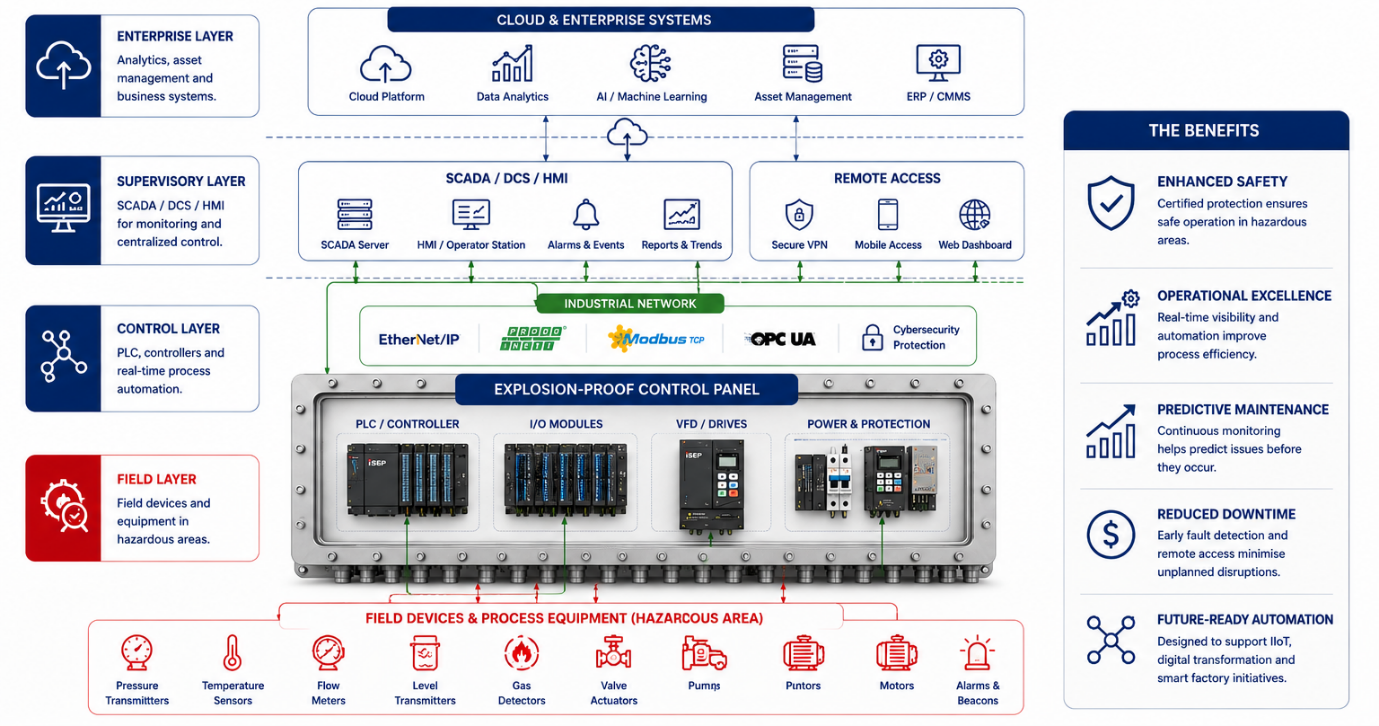
Today's explosion-proof control panels increasingly support Industry 4.0 technologies, including:
- Remote monitoring
- SCADA integration
- Industrial Ethernet
- Modbus
- PROFINET
- EtherNet/IP
- Predictive maintenance
- IIoT connectivity
- Condition monitoring
With appropriate hazardous area certification, facilities can enjoy advanced automation without compromising safety.
Key Factors When Choosing an Explosion-Proof Control Panel
When selecting a control panel, consider:
- Hazardous area classification
- Required certification (IECEx, ATEX, NEC)
- Environmental conditions
- Motor loads
- Future expansion
- Communication protocols
- Thermal management
- Maintenance accessibility
- Spare capacity
- Local technical support
Choosing solely based on price often results in higher long-term costs through redesigns, downtime or compliance issues.
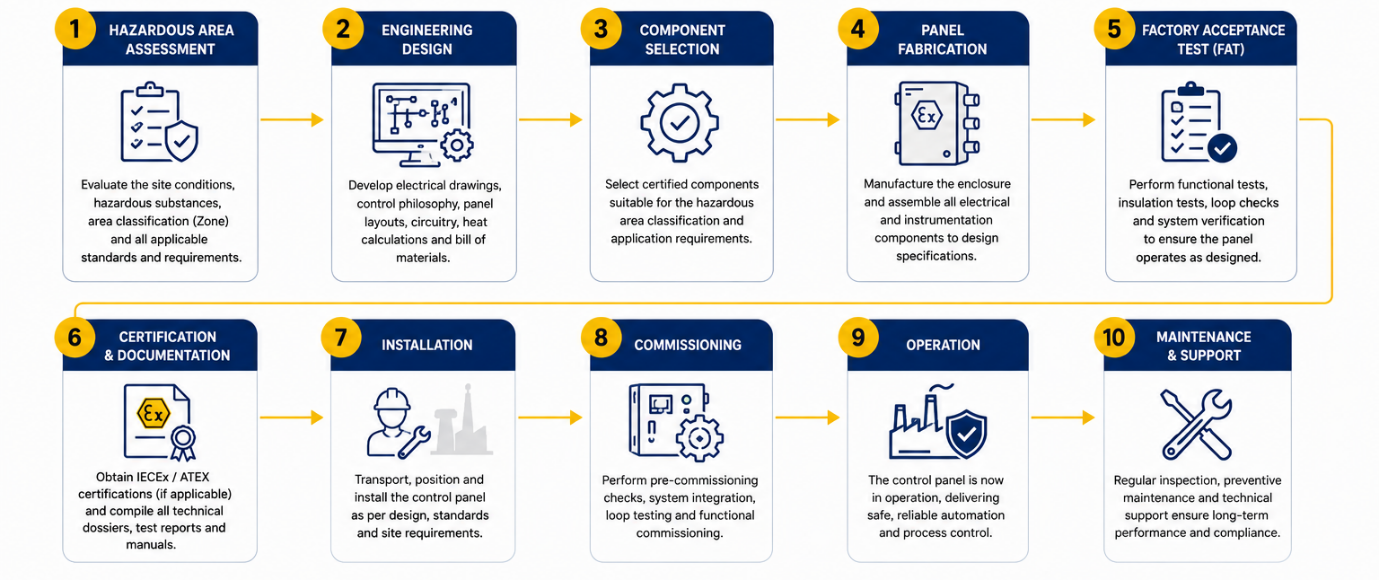
Common Mistakes to Avoid
Some of the most common issues encountered in hazardous area projects include:
- Selecting the wrong protection concept
- Underestimating internal heat generation
- Mixing intrinsically safe and non-intrinsically safe wiring
- Using uncertified cable glands
- Insufficient enclosure sizing
- Ignoring future expansion requirements
- Poor hazardous area classification
- Incorrect installation practices
Proper engineering during the design stage is significantly more cost-effective than rectifying problems after commissioning.
Why Work with an Experienced Explosion-Proof Panel Integrator?
Explosion-proof control panels involve much more than placing electrical components inside a rugged enclosure.
Successful projects require expertise in:
- Hazardous area engineering
- Electrical design
- Automation systems
- Thermal analysis
- International certification requirements
- Component compatibility
- Installation best practices
Working with an experienced hazardous area specialist helps ensure long-term safety, reliability and regulatory compliance.
Conclusion
Explosion-proof control panels form the heart of industrial automation in hazardous environments. By combining certified protection methods with modern control technologies, they enable industries to operate safely without sacrificing efficiency or productivity.
Whether controlling a single motor or an entire processing facility, every explosion-proof control panel should be engineered according to the site's hazardous area classification, operational requirements and applicable international standards.
If you are planning a new installation, upgrading an existing facility or selecting the right hazardous area automation solution, working with experienced explosion-proof specialists can help ensure your system remains safe, compliant and reliable for years to come.
ISEP Malaysia provides consultation, custom-built explosion-proof control panels, hazardous area engineering, IECEx and ATEX-compliant solutions, and technical support for industries including Oil & Gas, petrochemical, offshore, water treatment and manufacturing. Contact our team today to discuss the most suitable solution for your facility.
Contact Us
Speak with our certified specialists to select, design, or verify explosion-proof control panels customized for your facility requirements.
Frequently Asked Questions (FAQ)
An explosion-proof control panel is a specially engineered electrical control system designed for hazardous areas where flammable gases, vapours or combustible dust may be present. Unlike standard control panels, it uses certified protection methods such as Ex d (Flameproof), Ex e (Increased Safety), Ex p (Pressurization) or Ex i (Intrinsic Safety) to prevent electrical equipment from igniting explosive atmospheres. These panels commonly house PLCs, VFDs, relays, circuit breakers, instrumentation and motor control components while complying with international standards such as IECEx and ATEX.
A standard control panel is intended for non-hazardous environments and does not provide protection against explosive atmospheres. An explosion-proof control panel is specifically engineered for hazardous locations, featuring certified enclosures, explosion-proof cable entries, hazardous area-rated components and strict compliance with IECEx, ATEX or NEC standards. This enables safe operation in industries such as oil and gas, petrochemical processing and chemical manufacturing.
A typical explosion-proof control panel may include:
- PLC (Programmable Logic Controller)
- Variable Frequency Drive (VFD)
- Human Machine Interface (HMI)
- Circuit breakers and fuses
- Contactors and relays
- Motor starters
- Power supplies
- Terminal blocks
- Intrinsic safety barriers
- Industrial Ethernet switches
- Communication gateways
- Surge protection devices
The exact configuration depends on the application, hazardous area classification and required level of automation.
Explosion-proof control panels are widely used wherever flammable or explosive substances are present. Common industries include:
- Oil & Gas
- Petrochemical
- Refineries
- FPSO and FLNG facilities
- Chemical processing
- Pharmaceutical manufacturing
- Water and wastewater treatment
- Palm oil mills
- Grain and food processing
- Hydrogen production
- Mining
- Paint and coating facilities
These industries rely on hazardous area automation while maintaining compliance with international safety standards.
Yes, provided they are installed using the appropriate explosion protection concept. PLCs and VFDs are commonly integrated into explosion-proof control panels using Ex d, Ex p or other certified protection methods depending on the hazardous area classification. Proper enclosure selection, thermal management and certification are essential to ensure safe operation.
The required certification depends on the country and installation environment. Common certifications include:
- IECEx (International)
- ATEX (European Union)
- NEC Class/Division (North America)
- UL certification (United States)
- Compliance with the IEC 60079 series for explosive atmospheres
Selecting the correct certification ensures regulatory compliance and helps maintain a safe working environment.
Selecting the right explosion-proof control panel requires evaluating several engineering factors, including:
- Hazardous area classification (Zone or Class/Division)
- Type of flammable gas or combustible dust
- Temperature class (T-Class)
- Required control functions
- Motor size and electrical load
- Communication protocols (Modbus, PROFINET, EtherNet/IP, etc.)
- Environmental conditions
- Future expansion requirements
- Applicable certification standards
Working with an experienced hazardous area specialist can help ensure the panel is properly designed for your application.
Yes. Modern explosion-proof control panels increasingly support Industry 4.0 technologies, allowing seamless integration with SCADA systems, Distributed Control Systems (DCS), Industrial Internet of Things (IIoT) platforms and cloud-based monitoring solutions. Features such as predictive maintenance, condition monitoring, real-time diagnostics and remote access enable safer, more efficient operation without compromising hazardous area compliance.
Regular inspection and preventive maintenance are essential to ensure continued safety and compliance. Inspection intervals depend on the operating environment, equipment usage and applicable regulations. Maintenance typically includes checking flamepaths, cable glands, seals, electrical connections, corrosion, enclosure integrity and the operation of safety devices. Following manufacturer recommendations and standards such as IEC 60079-17 helps maximise reliability and minimise unplanned downtime.
When purchasing an explosion-proof control panel in Malaysia, choose a supplier with proven expertise in hazardous area engineering, international certifications and industrial automation. Beyond supplying certified equipment, an experienced provider should also offer consultation, custom panel design, system integration, testing, installation support and after-sales service. This helps ensure your control panel is properly matched to your hazardous area classification, operational requirements and long-term reliability goals.