
Explosion-Proof Cable Glands Explained:
Types, Standards, Applications and Selection Guide
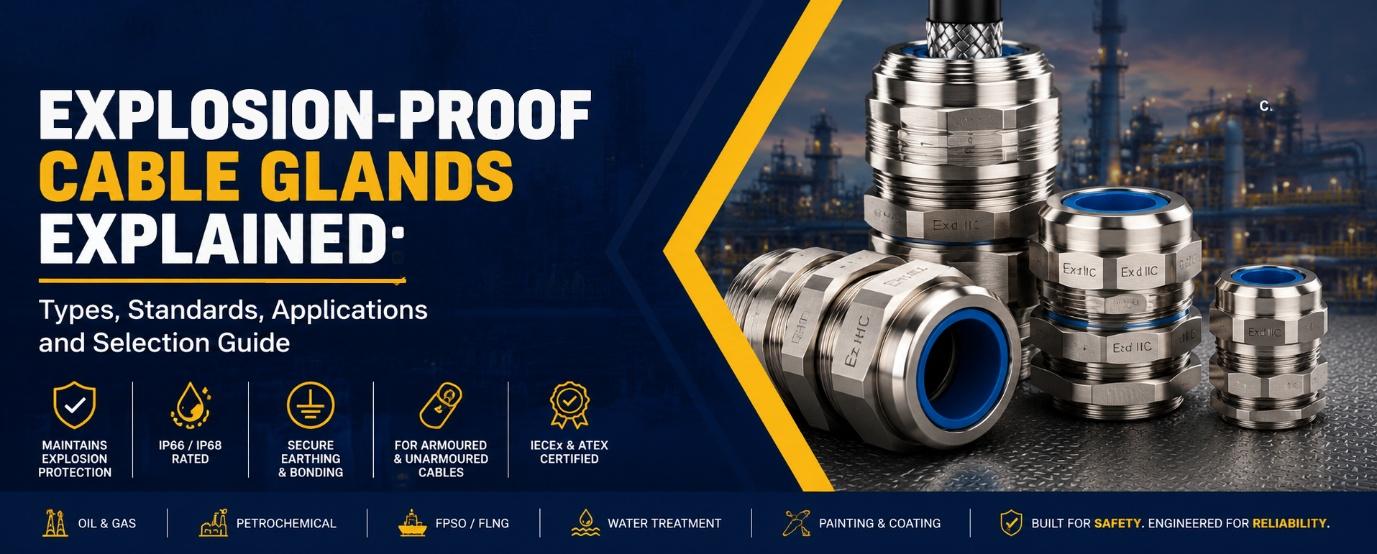
An explosion-proof electrical installation is only as safe as its weakest component.
While engineers often focus on explosion-proof control panels, junction boxes, lighting fixtures or flameproof enclosures, one small component is frequently overlooked—the explosion-proof cable gland.
Despite its relatively simple appearance, a cable gland is a critical part of every hazardous area electrical system. It secures the cable, maintains the enclosure's ingress protection (IP) rating, preserves grounding continuity, and—most importantly—helps maintain the explosion protection of the equipment itself.
Using an ordinary cable gland on certified hazardous area equipment can compromise the equipment's certification, potentially allowing flammable gases, vapours or combustible dust to enter the enclosure or, in certain situations, permitting flames or hot gases to escape during an internal fault.
Whether you're designing a new installation or upgrading an existing facility, understanding how hazardous area cable glands work can help improve safety, regulatory compliance and long-term system reliability.
Need Help Selecting the Right Cable Gland?
Need assistance selecting the right explosion-proof cable gland? ISEP's hazardous area specialists can recommend certified IECEx and ATEX cable glands that match your enclosure, cable type and hazardous area classification—helping you achieve safe, compliant and reliable installations from the outset.
What Is an Explosion-Proof Cable Gland?
An explosion-proof cable gland, also known as an Ex cable gland, hazardous area cable gland, or explosive atmosphere cable gland, is a specialised cable entry device designed for electrical equipment operating in hazardous locations.
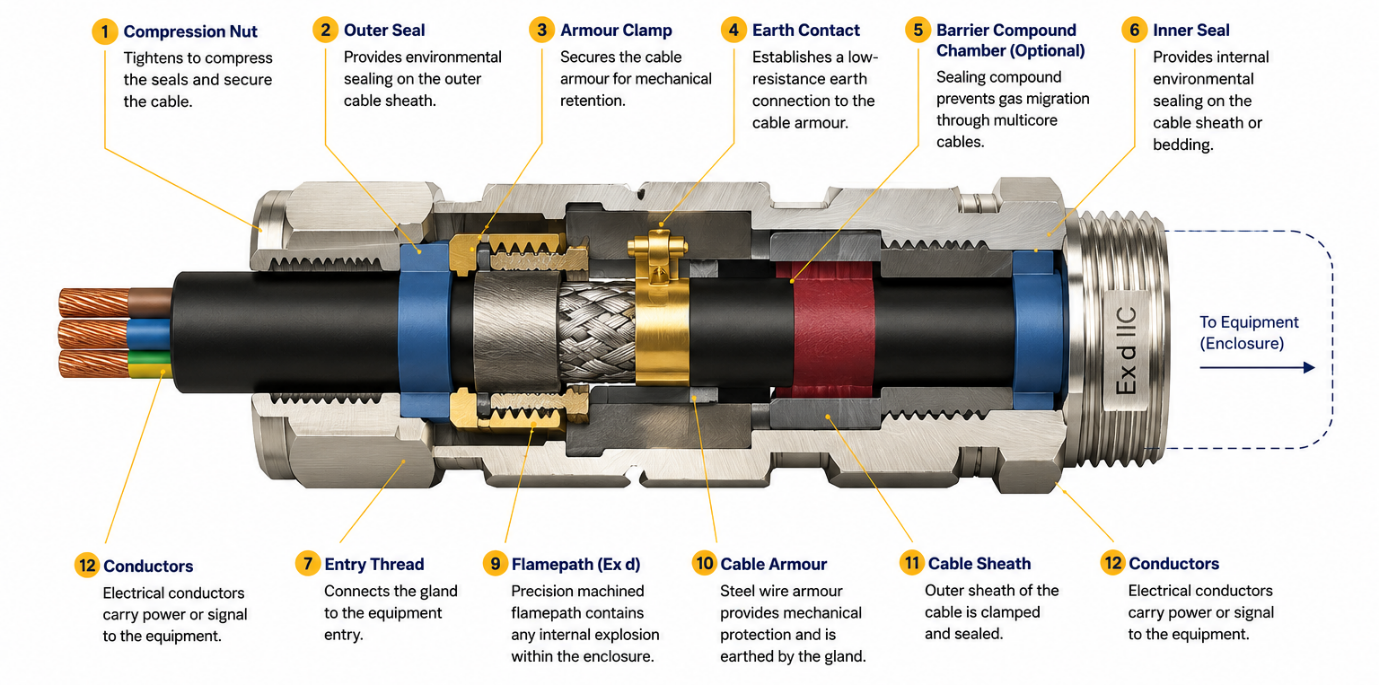
Unlike conventional cable glands used in general industrial environments, explosion-proof cable glands are engineered and certified to maintain the explosion protection of electrical equipment installed where flammable gases, vapours, mists or combustible dust may be present.
Depending on the application, an Ex cable gland performs several important functions:
- Securely anchors the cable to prevent movement or pull-out
- Maintains environmental sealing against water, dust and contaminants
- Preserves the enclosure's IP66 or IP68 ingress protection rating
- Provides electrical bonding and grounding for armoured cables
- Maintains the explosion protection concept of the enclosure
- Prevents hazardous gas migration in applications requiring barrier glands
Although relatively small, the cable gland is often one of the most safety-critical components in an explosion-proof electrical installation.
Why Are Explosion-Proof Cable Glands So Important?
Imagine investing in a fully certified flameproof enclosure, only to install an uncertified cable gland.
The enclosure itself may meet all international standards, yet the entire protection system could be compromised by a single incorrect cable entry.
Cable glands are much more than cable holders—they are an integral part of the enclosure's certified protection system.
A properly selected hazardous area cable gland helps:
- Prevent explosive gas or vapour ingress
- Prevent combustible dust from entering the enclosure
- Maintain the enclosure's certified IP rating
- Prevent cable movement caused by vibration or mechanical stress
- Maintain electrical earth continuity for cable armour
- Preserve flamepaths and explosion containment in flameproof equipment
In hazardous environments, every cable entry matters.
How Does an Explosion-Proof Cable Gland Work?
Although different protection concepts use different engineering principles, most explosion-proof cable glands perform four key functions.
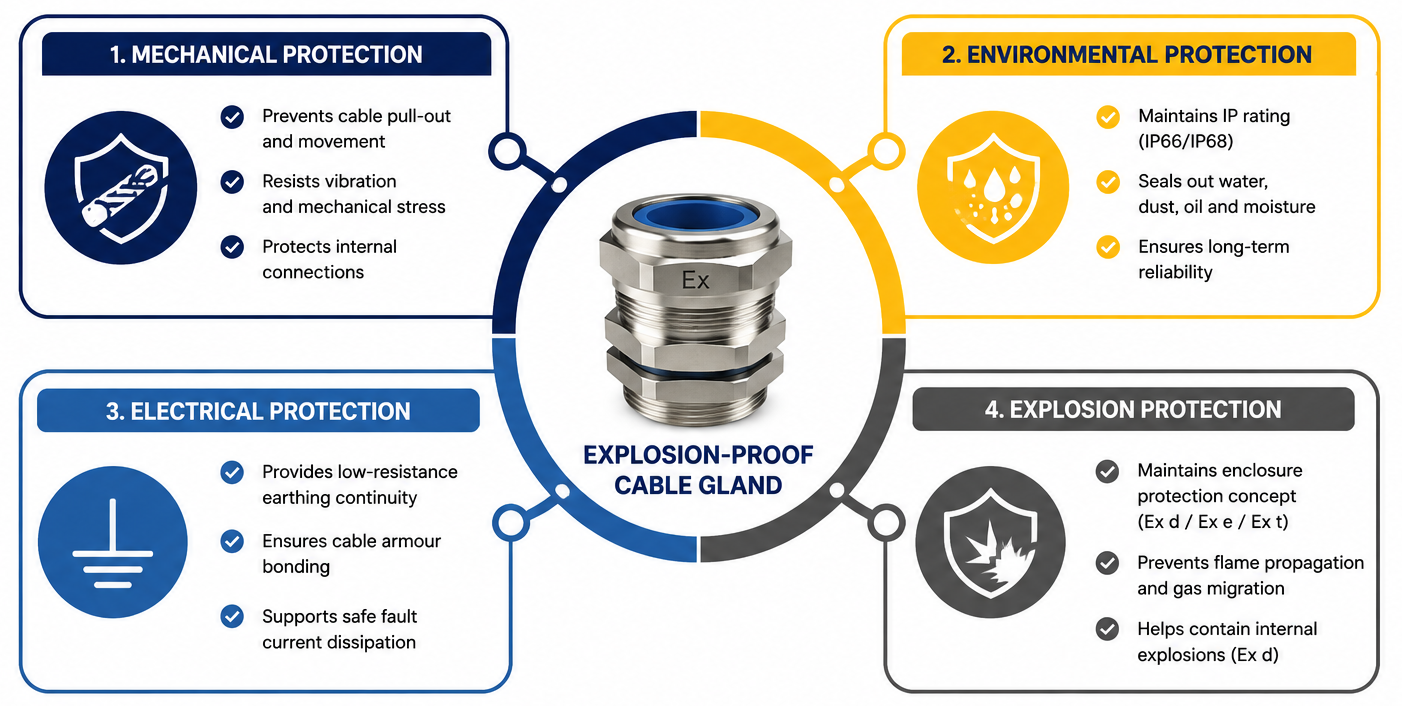
1. Mechanical Cable Retention
The gland grips the cable securely to prevent movement caused by:
- vibration
- accidental pulling
- equipment movement
- thermal expansion
This reduces stress on internal electrical terminations and improves long-term reliability.
2. Environmental Sealing
High-quality elastomer seals compress around the cable sheath to prevent ingress of:
- rainwater
- moisture
- oil
- dust
- corrosive contaminants
Most modern IECEx cable glands provide IP66 and IP68 protection when correctly installed.
3. Explosion Protection
Depending on the protection concept, the gland helps preserve the certified explosion protection of the enclosure.
For example:
- Ex d (Flameproof) cable glands help maintain flamepaths and, where required, prevent gas migration.
- Ex e (Increased Safety) cable glands maintain secure cable retention and environmental sealing to minimise the risk of ignition.
- Ex t cable glands provide dust-tight sealing for combustible dust environments.
4. Electrical Bonding and Earthing
For Steel Wire Armoured (SWA) and other armoured cables, the gland establishes a low-resistance electrical connection between the cable armour and the enclosure.
This provides a reliable earth path for fault currents while maintaining the integrity of the hazardous area installation.
Types of Explosion-Proof Cable Glands
Selecting the correct explosion-proof cable gland depends on the equipment protection concept, hazardous area classification and cable construction.
Comparison of the main explosion-proof cable gland types and their typical applications (IEC, 2023).
| Cable Gland Type | Primary Function | Typical Equipment | Suitable Cable |
|---|---|---|---|
| Ex d | Flame containment | Flameproof enclosures | Armoured & selected unarmoured |
| Ex e | Increased safety | Terminal boxes | Armoured & unarmoured |
| Barrier | Prevent gas migration | Ex d equipment | Armoured & unarmoured, Multicore cables |
| Ex t | Dust exclusion | Dust hazard equipment | Various industrial cables |
Ex d Cable Glands (Flameproof)
Ex d cable glands are designed for flameproof enclosures where an internal explosion may occur.
Rather than preventing an explosion, these glands help ensure any internal explosion remains safely contained within the enclosure without igniting the surrounding atmosphere.
Typical applications include:
- Oil & Gas
- Refineries
- Petrochemical plants
- FPSO and FLNG facilities
- Chemical processing plants
Ex e Cable Glands (Increased Safety)
Ex e cable glands are designed for equipment that prevents sparks, arcs and excessive surface temperatures during normal operation.
Their primary role is to maintain:
- mechanical retention
- environmental sealing
- ingress protection
- cable integrity
They are commonly installed on:
- terminal boxes
- instrumentation
- control stations
- hazardous area lighting
Barrier Cable Glands
Barrier cable glands provide one of the highest levels of protection.
Unlike standard compression glands, they seal around each conductor using a certified barrier compound or resin.
This prevents explosive gases from travelling through the internal spaces of multicore cables—a phenomenon known as gas migration.
Barrier cable glands are commonly required for certain Ex d installations, particularly where specified by applicable standards or project requirements.
Ex t Cable Glands
Ex t cable glands are designed specifically for combustible dust environments.
Their primary function is to maintain a dust-tight seal that prevents combustible dust from entering the enclosure and accumulating around hot electrical components.
Typical industries include:
- food processing
- grain handling
- pharmaceuticals
- cement manufacturing
- wood processing
Single Compression vs Double Compression Cable Glands
One of the most common questions during cable gland selection is whether to use a single or double compression design.
| Feature | Single Compression | Double Compression |
|---|---|---|
| Cable grip | Outer sheath only | Inner and outer sheath |
| Mechanical strength | Moderate | High |
| Suitable cable | Unarmoured | Armoured |
| Vibration resistance | Moderate | Excellent |
| Outdoor use | Suitable | Highly suitable |
| Hazardous industries | Selected applications | Widely used |
Double compression cable glands provide enhanced sealing and mechanical strength, making them the preferred choice for many heavy industrial and hazardous area installations.
What Is a Barrier Cable Gland?
Barrier cable glands are among the most misunderstood hazardous area components.
Many multicore power and instrumentation cables contain tiny spaces between individual conductors.
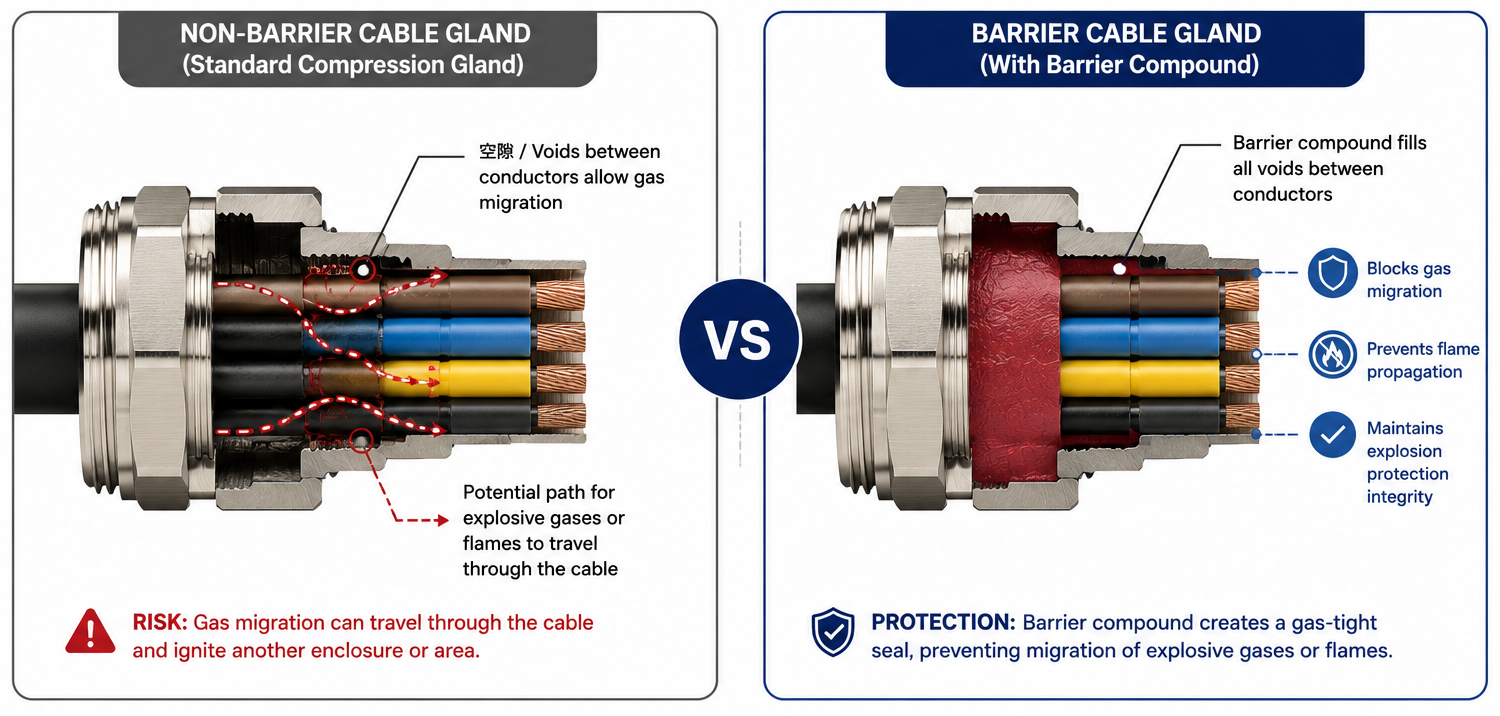
During an internal explosion inside an Ex d enclosure, hot gases may travel through these internal voids and potentially reach another enclosure further along the cable.
Barrier glands eliminate this risk by filling these spaces with a specially formulated sealing compound, creating a solid gas-tight barrier around each conductor.
For this reason, barrier glands are frequently specified in high-risk hazardous area applications and are increasingly important under modern installation practices.
Common Materials Used
Explosion-proof cable glands are available in several materials depending on the operating environment.
Nickel-Plated Brass
The most widely used material due to its excellent balance of:
- corrosion resistance
- mechanical strength
- durability
- cost-effectiveness
Stainless Steel
Ideal for highly corrosive environments including:
- offshore platforms
- marine applications
- chemical plants
- pharmaceutical facilities
Engineering Nylon
Typically used for general industrial applications rather than flameproof or hazardous area installations.
Key Standards and Certifications
Explosion-proof cable glands should always comply with recognised international standards appropriate for the installation.
Some of the most important standards include:
IEC 60079 Series
The internationally recognised IEC 60079 series forms the foundation of hazardous area electrical equipment design and installation.
Key parts include:
- IEC 60079-0 – General requirements for explosion-protected equipment
- IEC 60079-1 – Flameproof enclosures (Ex d)
- IEC 60079-7 – Increased safety (Ex e)
- IEC 60079-14 – Selection and installation of electrical equipment in hazardous areas
- IEC 60079-31 – Equipment protection by enclosure for combustible dust (Ex t)
IECEx Certification
IECEx is an internationally recognised certification scheme that demonstrates equipment has been independently tested and certified for use in explosive atmospheres.
Many multinational projects specify IECEx-certified cable glands to facilitate global acceptance and consistent safety standards.
ATEX Certification
ATEX is the European regulatory framework governing equipment intended for potentially explosive atmospheres.
Although specific to Europe, ATEX-certified cable glands are widely recognised throughout international industries.
Other Regional Standards
Depending on the project location, additional compliance may be required, including:
- NEC (National Electrical Code)
- CEC (Canadian Electrical Code)
- UL requirements
Always ensure the cable gland certification matches both the hazardous area classification and the protection concept of the equipment.
Common Cable Gland Selection Mistakes
Many hazardous area failures result from incorrect cable gland selection rather than equipment failure.
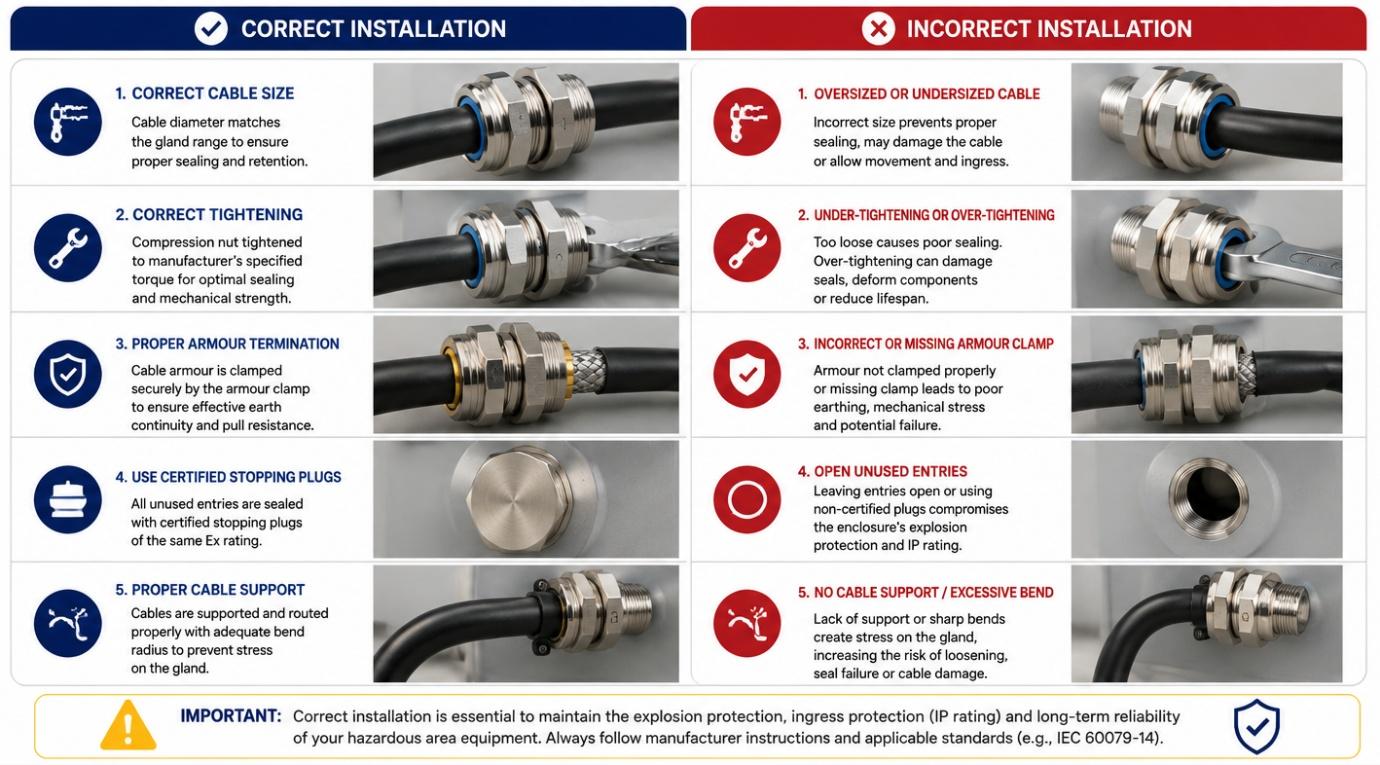
Common mistakes include:
- Installing ordinary cable glands on explosion-proof equipment
- Selecting the wrong cable diameter
- Choosing Ex e glands where Ex d glands are required
- Failing to use barrier glands when specified
- Mixing incompatible metals, increasing corrosion risk
- Incorrect tightening torque
- Poor cable armour termination
- Using uncertified reducers, adaptors or stopping plugs
- Selecting the wrong IP rating for the environment
Careful specification and correct installation help ensure the safety and longevity of the entire electrical system.
Typical Applications
Explosion-proof cable glands are widely used in industries where explosive atmospheres may be present, including:
- Oil & Gas
- Petrochemical
- Chemical manufacturing
- FPSO and FLNG facilities
- Water and wastewater treatment
- Hydrogen production
- Battery manufacturing
- Mining
- Paint spray booths
- Pharmaceutical manufacturing
- Grain storage
- Food processing
How to Choose the Right Explosion-Proof Cable Gland
Choosing the right cable gland involves much more than simply matching the cable diameter.
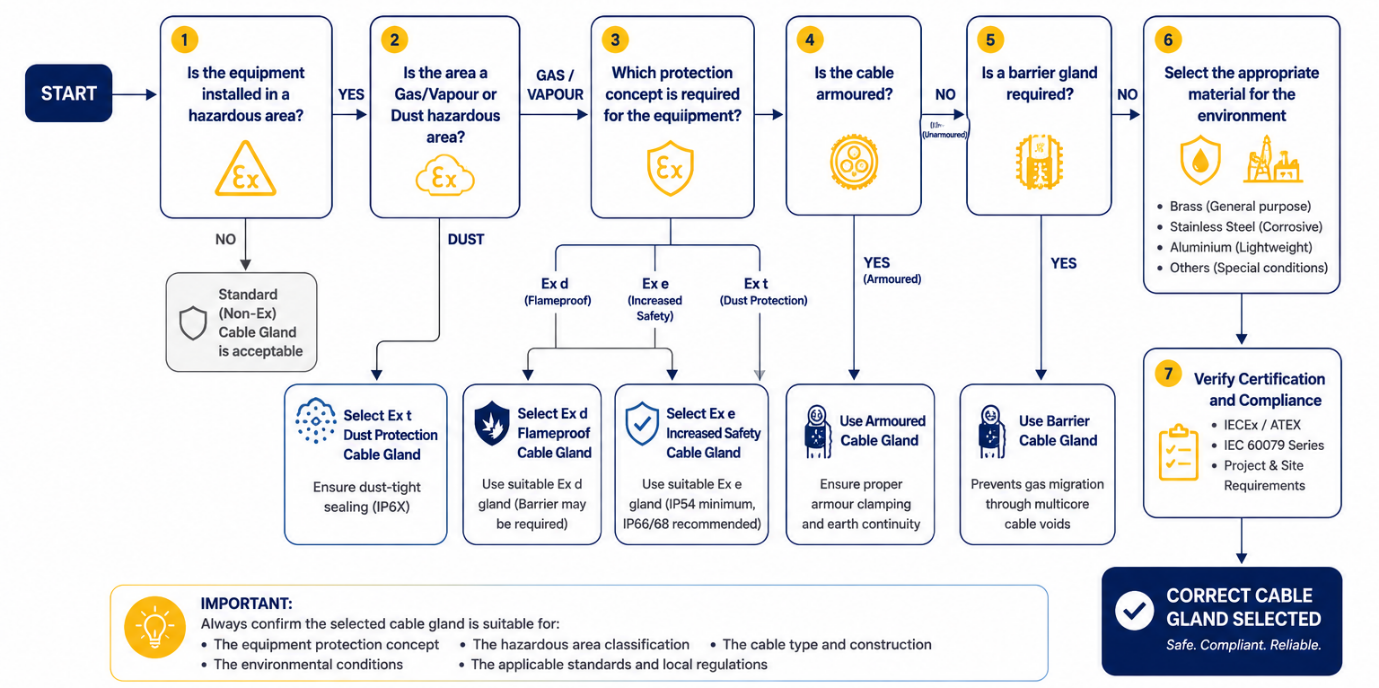
Engineers should consider:
- Hazardous area classification (Zone 1, Zone 2, Zone 21 or Zone 22)
- Gas group (e.g., Gas Group IIA, IIB or IIC)
- Equipment protection concept (Ex d, Ex e or Ex t)
- Cable construction (armoured or unarmoured)
- Cable armour type (such as SWA)
- Environmental conditions
- Required IP rating (e.g., IP66 or IP68)
- Operating temperature
- Corrosion resistance
- Certification requirements (IECEx, ATEX or regional standards)
Selecting the correct cable gland from the outset improves safety, simplifies compliance and reduces maintenance costs throughout the equipment's service life.
Practical checklist for selecting a certified explosion-proof cable gland for hazardous area installations (IEC, 2024).
| Selection Factor | Why It Matters |
|---|---|
| Hazardous Area Zone | Determines certification required |
| Gas/Dust Group | Determines protection level |
| Ex Protection Concept | Ex d, Ex e, Ex t compatibility |
| Cable Type | Armoured or unarmoured |
| Cable Diameter | Correct sealing performance |
| Material | Corrosion resistance |
| IP Rating | Environmental protection |
| Certification | IECEx / ATEX / UL |
Conclusion
Although often overlooked, the explosion-proof cable gland is one of the most important components in any hazardous area electrical installation. It not only secures cables and maintains ingress protection, but also plays a critical role in preserving explosion protection, grounding continuity and overall system integrity.
From selecting the correct Ex d or Ex e cable gland to determining whether a barrier cable gland is required, every decision should be based on the hazardous area classification, cable construction, environmental conditions and applicable standards. Investing in the right cable gland today helps reduce future maintenance issues, improve compliance and enhance operational safety.
Talk to ISEP About Explosion-Proof Cable Glands
Choosing the wrong cable gland can affect equipment certification, ingress protection, grounding continuity and the long-term reliability of your hazardous area installation.
Whether you're designing a new Oil & Gas facility, upgrading instrumentation in a petrochemical plant, or replacing existing hazardous area cable entry systems, ISEP's explosion-proof specialists can help you select the correct IECEx- and ATEX-certified explosion-proof cable glands based on your enclosure type, cable construction, hazardous area classification and project requirements.
Beyond supplying certified hazardous area cable glands, ISEP provides technical guidance on explosion-proof equipment selection, hazardous area compliance and integrated electrical solutions—helping you build safer, more reliable and standards-compliant installations.
Contact Us Today
Speak with our certified specialists to select, design, or verify explosion-proof cable gland systems customized for your facility requirements.
Frequently Asked Questions (FAQ)
A standard cable gland is designed to secure cables and provide basic environmental sealing in general industrial or commercial applications. In contrast, an explosion-proof cable gland (also known as an Ex cable gland or hazardous area cable gland) is specifically engineered and certified for use in explosive atmospheres. It helps maintain the explosion protection of the equipment by providing secure cable retention, preserving ingress protection (IP ratings), maintaining grounding continuity, and supporting the enclosure's certified protection concept, such as Ex d or Ex e.
A barrier cable gland is typically required when terminating certain multicore cables into flameproof (Ex d) equipment where there is a risk of explosive gas migrating through the spaces between cable conductors. Requirements depend on factors such as the hazardous area classification, cable construction, enclosure type, gas group and applicable standards such as IEC 60079-14. Engineers should always verify project specifications and manufacturer recommendations before selecting a barrier gland.
Not necessarily. Although some cable glands carry dual certification (such as Ex d and Ex e), not every Ex e cable gland is suitable for use on a flameproof enclosure. The cable gland must be certified for the protection concept of the equipment and comply with the installation requirements for that application. Using the wrong gland may invalidate the equipment's hazardous area certification.
Choosing the correct cable gland size involves more than matching the cable's outside diameter. You should also consider the cable type (armoured or unarmoured), cable construction, armour diameter, hazardous area classification, enclosure thread size, required IP rating, and applicable certification standards. Selecting the correct size ensures proper sealing, mechanical retention and long-term reliability.
The best material depends on the operating environment. Nickel-plated brass is widely used because it offers excellent mechanical strength and corrosion resistance at a competitive cost. Stainless steel is preferred for highly corrosive environments such as offshore platforms, marine facilities and chemical plants. Aluminium may be selected where weight reduction is important, while engineering nylon is generally used for non-hazardous industrial applications.
IECEx and ATEX are different certification systems, but many manufacturers produce cable glands that comply with both. IECEx is an international certification scheme recognised in many countries, while ATEX is the European regulatory framework for equipment used in potentially explosive atmospheres. Depending on your project location and client specifications, one or both certifications may be required.
A single compression cable gland seals around the cable's outer sheath and is commonly used with unarmoured cables in less demanding environments. A double compression cable gland seals both the inner bedding and outer sheath while securely clamping the cable armour, providing superior mechanical strength, environmental sealing and vibration resistance. Double compression glands are commonly used in heavy industrial and hazardous area installations.
Yes. Most certified explosion-proof cable glands are designed for demanding indoor and outdoor industrial environments. Many are rated IP66 for protection against powerful water jets and IP68 for continuous water immersion under specified conditions. When selecting a cable gland for outdoor use, engineers should also consider UV exposure, corrosion resistance, operating temperature and chemical compatibility.
Explosion-proof cable glands should be inspected as part of the facility's routine hazardous area maintenance programme. Regular inspections should check for loose compression nuts, corrosion, damaged seals, deterioration of elastomer components, mechanical damage and loss of grounding continuity. Inspection intervals should follow applicable standards, manufacturer recommendations and the site's maintenance procedures.
Selecting an explosion-proof cable gland involves evaluating much more than cable diameter. Engineers must consider hazardous area classification, gas or dust group, equipment protection concept (such as Ex d or Ex e), cable construction, armour type, environmental conditions, certification requirements and installation practices. Professional selection helps reduce installation errors, maintain regulatory compliance and improve the long-term safety and reliability of the entire hazardous area electrical system.