
Explosion-Proof Electrical Box:
Complete Guide to Hazardous Area Enclosures, Certifications and Industrial Applications
What Is an Explosion-Proof Electrical Box?
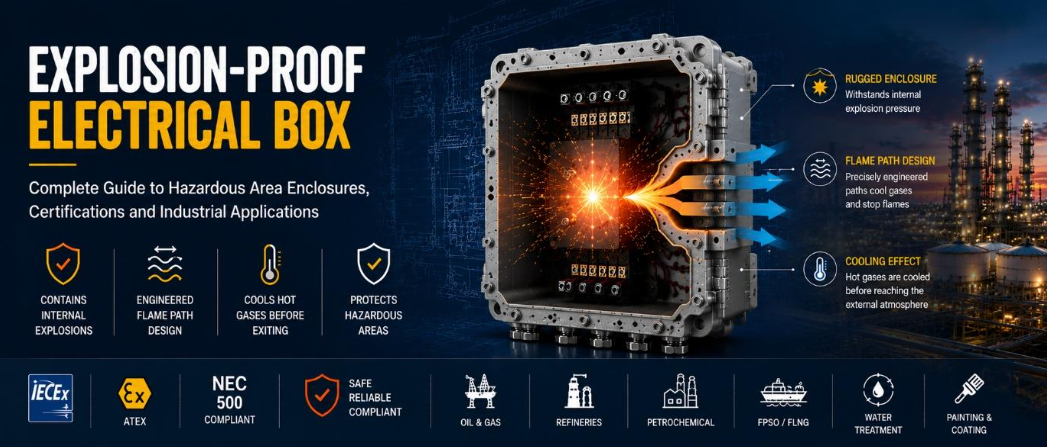
An explosion-proof electrical box is a specially engineered enclosure designed to safely house electrical equipment in hazardous areas where flammable gases, vapours, mists, or combustible dust may be present.
These explosion-proof enclosures are widely used in industries such as Oil & Gas, petrochemical processing, refineries, FPSO facilities, FLNG, chemical manufacturing, water treatment plants, and paint processing facilities, where even a small electrical spark can trigger a catastrophic explosion.
Unlike conventional electrical enclosures, an explosion-proof electrical box is designed to contain an internal explosion and prevent flames, sparks, or hot gases from igniting the surrounding atmosphere.
This makes explosion-proof electrical enclosures a critical safety component in facilities operating within Zone 1, Zone 2, Class I Division 1, and Class I Division 2 hazardous locations.
Selecting an explosion-proof electrical box involves more than simply choosing an enclosure size. Factors such as hazardous area classification, gas group, temperature class; External factors such as corrosion or high ambient temperature will also affect the material selection and certification requirements all play a role in ensuring safety and compliance. If you are planning a new installation, upgrading existing equipment, or evaluating hazardous area requirements, consulting an experienced specialist like ISEP early in the process can help prevent costly specification errors and improve long-term reliability.
Why Are Explosion-Proof Electrical Boxes Important?
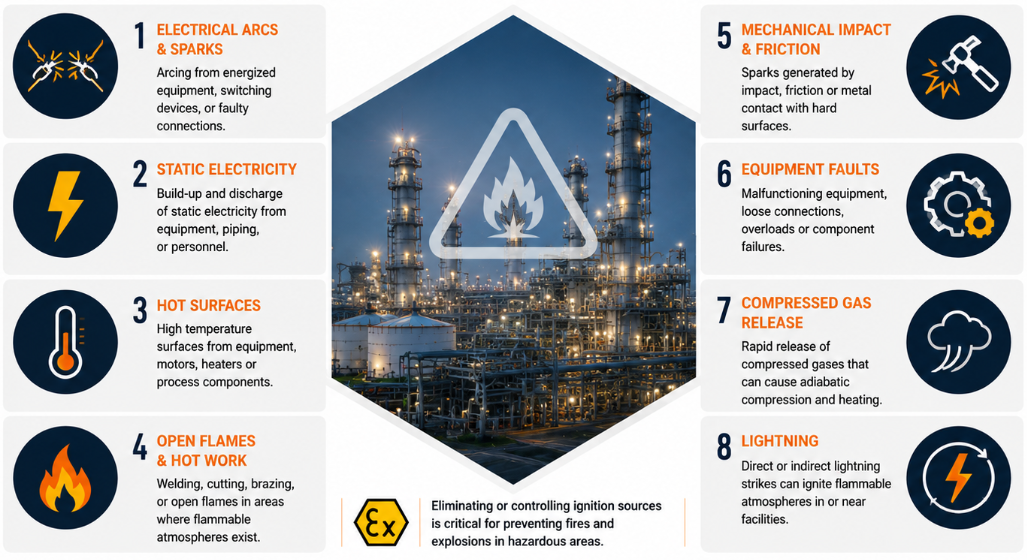
Many industrial environments contain substances that can easily ignite when exposed to heat, sparks, or electrical arcs.
Examples include:
- Natural gas
- Hydrogen
- Methane
- LPG
- Solvent vapours
- Petrochemical gases
- Hydrogen sulphide
- Ethylene
- Acetylene
- Combustible dust
In these environments, ordinary electrical equipment may generate:
- Electrical sparks
- Switching arcs
- Static discharge
- High surface temperatures
- Equipment faults
Without proper protection, these ignition sources can cause fires, explosions, production shutdowns, equipment damage, environmental incidents, and serious injuries.
Explosion-proof electrical boxes help minimise these risks by safely containing potential ignition events before they can spread into the surrounding hazardous atmosphere.
How Does an Explosion-Proof Electrical Box Work?
A common misconception is that explosion-proof enclosures prevent flammable gases from entering the enclosure.
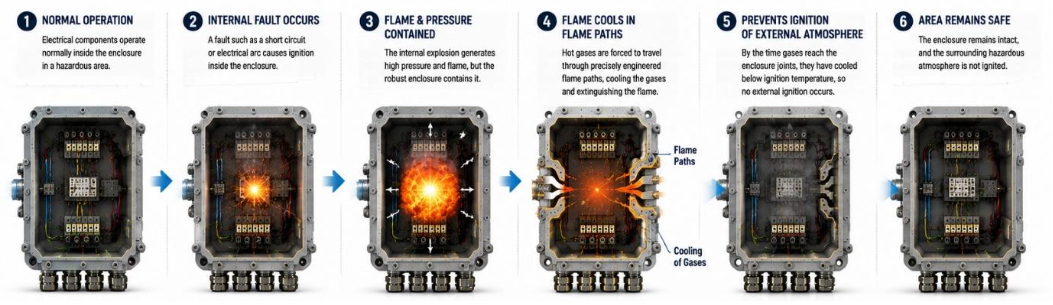
In reality, explosion-proof designs assume that gases or vapours may eventually enter the enclosure over time. Instead of preventing gas ingress, the enclosure is designed to safely contain an internal ignition.
The process works as follows:
This protection concept is known as Flameproof Protection (Ex d) and is one of the most widely used explosion protection methods under IECEx and ATEX standards.
What Is a Flameproof or Ex d Enclosure?
A flameproof enclosure, often referred to as an Ex d enclosure, is designed to withstand and contain an internal explosion without transmitting the ignition source to the external environment.
The term "Ex d" originates from the IEC 60079 series of hazardous area standards and remains one of the most widely accepted explosion protection methods worldwide.
Ex d enclosures are commonly used to house:
- Motor starters
- Control equipment
- Electrical panels
- Instrumentation equipment
- Communication devices
- Control stations
- Industrial automation systems
Because of their robust design, Ex d enclosures remain one of the preferred protection methods in high-risk hazardous areas.
What Is a Flame Path?
The most important safety feature inside an explosion-proof electrical box is the flame path.
A flame path is a precisely machined gap between two mating surfaces of the enclosure, usually between the cover and the enclosure body.
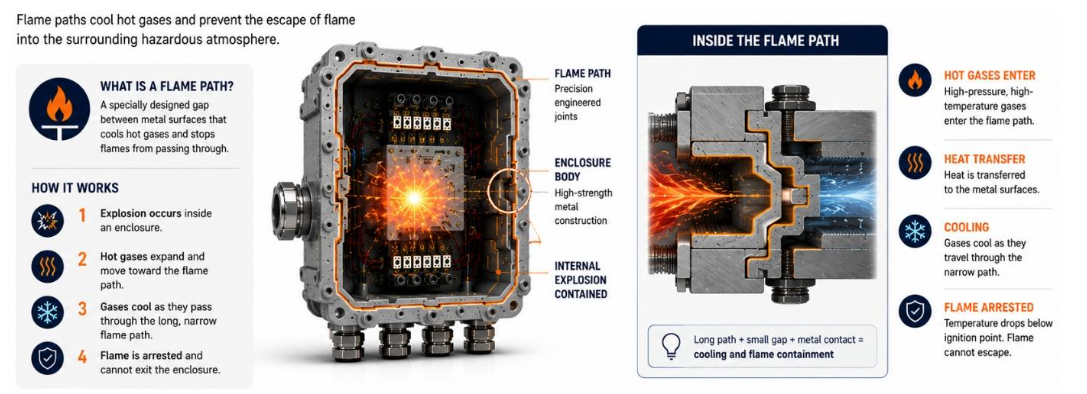
When hot gases from an internal explosion attempt to escape:
- The gases are forced through a narrow passage.
- Heat is absorbed by the enclosure walls.
- Gas temperature decreases rapidly.
- The flame is extinguished before reaching the external environment.
This prevents the ignition of surrounding flammable gases and forms the fundamental principle behind explosion-proof enclosure design.
Explosion-Proof Electrical Box vs Standard Electrical Enclosure
Many people mistakenly believe that a weatherproof or waterproof enclosure provides the same level of protection as an explosion-proof enclosure. This is not true.
| Feature | Standard Enclosure | Explosion-Proof Electrical Box |
|---|---|---|
| Protects Against Dust & Water | Yes | Yes |
| Contains Internal Explosion | No | Yes |
| Suitable for Hazardous Areas | No | Yes |
| Certified to IECEx / ATEX | No | Yes |
| Suitable for Flammable Gas Environments | No | Yes |
| Designed with Flame Paths | No | Yes |
Common Materials Used in Explosion-Proof Electrical Boxes
Material selection plays a major role in enclosure performance, durability, and compliance.
Copper-free aluminium is one of the most popular materials for explosion-proof electrical enclosures. Benefits include: Lightweight construction, Excellent heat dissipation, Good corrosion resistance, Easier installation, and Lower structural loading. It is widely used in refineries, petrochemical plants, and offshore facilities.
Stainless steel enclosures provide exceptional resistance against: Salt spray, Corrosion, Chemicals, and Harsh marine environments. These are commonly selected for: Offshore platforms, LNG terminals, Marine vessels, Coastal facilities, and Chemical plants.
Cast iron offers: Excellent impact resistance, High mechanical strength, and Robust protection in harsh industrial environments. However, it is significantly heavier than aluminium alternatives.
Industries That Use Explosion-Proof Electrical Boxes
Explosion-proof electrical boxes are found throughout hazardous industries worldwide.
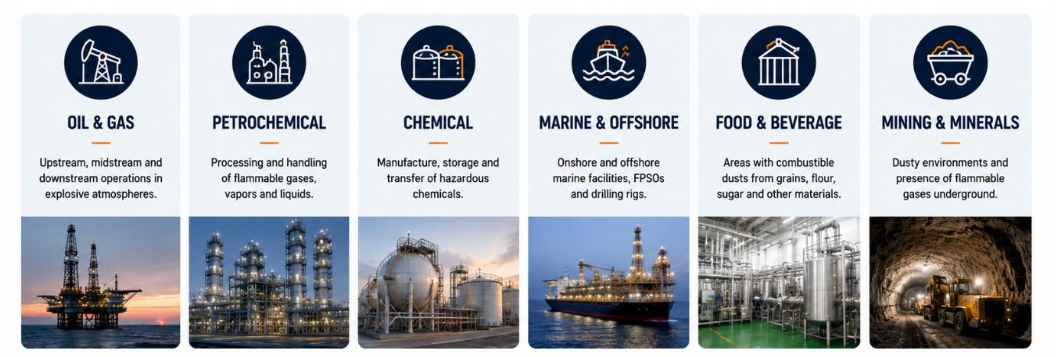
- Oil and Gas Industry: Used in offshore platforms, onshore processing plants, gas compression stations, and storage terminals.
- Petrochemical Plants: Protecting electrical systems in areas containing volatile hydrocarbons and solvents.
- Refineries: Safeguarding equipment exposed to flammable process streams.
- FPSO and FLNG Facilities: Supporting safe operation in offshore production and liquefaction environments.
- Water Treatment Plants: Protecting electrical equipment in locations where methane or hydrogen sulphide may accumulate.
- Paint and Coating Facilities: Preventing ignition of solvent-rich atmospheres.
- Chemical Manufacturing: Reducing explosion risks associated with flammable process chemicals.
Understanding Hazardous Area Classifications
Selecting the correct explosion-proof electrical box requires understanding hazardous area classifications.
IECEx and ATEX Zones
For gases and vapours:
- Zone 0 – Hazard continuously present
- Zone 1 – Hazard likely during normal operation
- Zone 2 – Hazard unlikely but possible
For combustible dust:
- Zone 20
- Zone 21
- Zone 22
NEC Class and Division System
Commonly used in North America:
- Class I Division 1
- Class I Division 2
- Class II Division 1
- Class II Division 2
The enclosure selected must match the specific hazardous area classification.
Table comparing IECEx/ATEX Zones and NEC Class & Division Systems
| Aspect | IECEx / ATEX System | NEC 500 Class & Division System |
|---|---|---|
| Primary Usage | International (Europe, Asia, Middle East, Australia, Africa) | North America (USA, Canada) |
| Governing Standards | IEC 60079 Series | NFPA 70 (NEC 500) |
| Hazard Type | Gas, vapour, mist, and dust | Gas, vapour, liquid, and dust |
| Classification Method | Zones | Classes & Divisions |
| Continuous Presence of Hazard | Zone 0 | Class I Division 1 |
| Hazard Likely During Normal Operation | Zone 1 | Class I Division 1 |
| Hazard Present Only Under Abnormal Conditions | Zone 2 | Class I Division 2 |
| Combustible Dust (Continuous) | Zone 20 | Class II Division 1 |
| Combustible Dust (Occasional) | Zone 21 | Class II Division 1 |
| Combustible Dust (Abnormal Conditions) | Zone 22 | Class II Division 2 |
| Equipment Marking Example | Ex db IIB T4/T5/T6 Gb Ex db IIC T4/T5/T6 Gb |
Class I, Div 1, Groups C & D, T4 |
| Typical Industries | Oil & Gas, Petrochemical, LNG, Offshore Platforms, Chemical Plants | Refineries, Chemical Plants, Industrial Facilities in North America |
| Common Certification Bodies | IECEx, ATEX | UL, FM Approvals, CSA |
| Global Acceptance | Widely accepted internationally | Primarily North America |
Simplified Equivalency Guide
| IECEx / ATEX Zone | Approximate NEC Equivalent | Typical Hazard Frequency |
|---|---|---|
| Zone 0 | Class I Division 1 | Hazard continuously present |
| Zone 1 | Class I Division 1 | Hazard likely during normal operation |
| Zone 2 | Class I Division 2 | Hazard unlikely, but may occur under abnormal conditions |
| Zone 20 | Class II Division 1 | Dust continuously present |
| Zone 21 | Class II Division 1 | Dust likely during normal operation |
| Zone 22 | Class II Division 2 | Dust present only under abnormal conditions |
Typical Examples
| Area | Typical Classification |
|---|---|
| Inside fuel storage tank | Zone 0 |
| Around tank vent or process equipment | Zone 1 |
| Area surrounding process equipment | Zone 2 |
| Grain silo interior | Zone 20 |
| Dust collection systems | Zone 21 |
| Areas around dust handling equipment | Zone 22 |
Explosion-Proof Electrical Box Certifications Explained
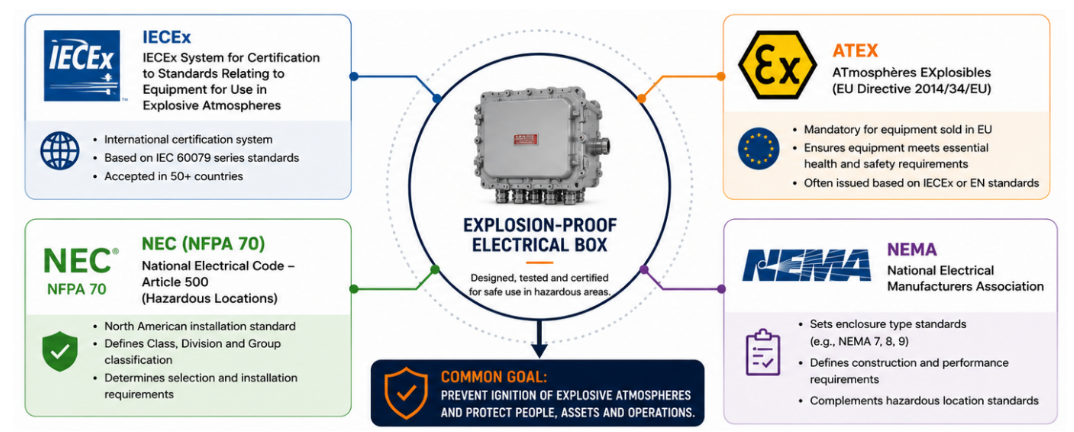
- IECEx Certification: IECEx is an internationally recognised certification scheme for equipment used in explosive atmospheres. It demonstrates compliance with the IEC 60079 series of standards.
- ATEX Certification: ATEX certification is required for hazardous area equipment used within the European Union.
- NEC 500 Compliance: North American installations commonly follow NEC 500 requirements for hazardous locations.
- NEMA Ratings: Explosion-proof enclosures may also carry NEMA 7 ratings, NEMA 9 ratings, or NEMA 4X ratings depending on application requirements.
How to Choose the Right Explosion-Proof Electrical Box
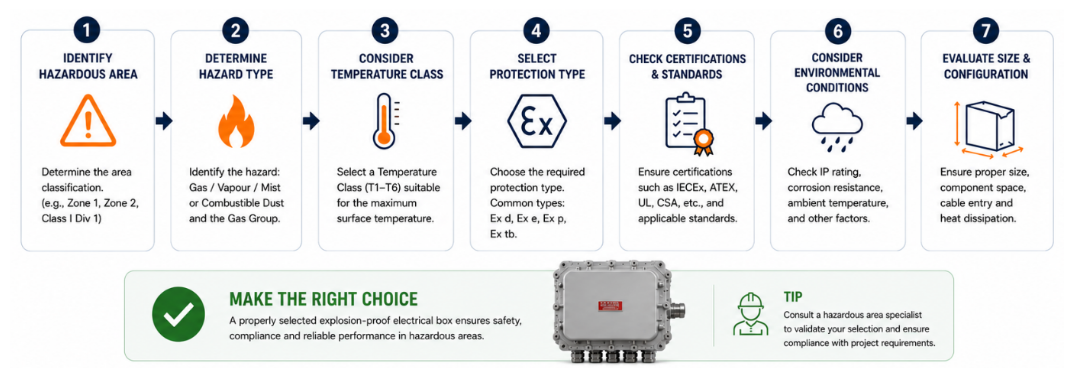
Selecting an explosion-proof enclosure requires more than simply choosing the correct size.
Important factors include:
- Hazardous Area Classification: Zone 1, Zone 2, Division 1, or Division 2.
- Gas Group: IIA, IIB, or IIC.
- Temperature Class: T1 through T6.
- Environmental Conditions: Indoor, outdoor, offshore, marine, or corrosive environments.
- Material Selection: Aluminium, stainless steel, or cast iron.
- Ingress Protection Rating: IP66, IP67, or higher where required.
- Certification Requirements: IECEx, ATEX, NEC, or project-specific standards.
Proper equipment selection helps ensure safety, compliance, and long-term reliability.
Common Mistakes When Selecting Explosion-Proof Enclosures
Many industrial incidents can be traced to specification or installation errors.
Common mistakes include:
- Using non-certified enclosures in hazardous areas
- Selecting the wrong gas group
- Choosing an incorrect temperature class
- Using uncertified cable glands
- Improper installation practices
- Failure to inspect flame paths
- Poor maintenance procedures
- Ignoring environmental corrosion risks
Working with experienced hazardous area specialists helps avoid these costly mistakes.
Why Work with a Hazardous Area Specialist?
Hazardous area compliance can be complex.
Engineers must consider:
- Hazardous area classification
- IECEx requirements
- ATEX requirements
- NEC 500 compliance
- Gas groups
- Temperature classes
- Equipment certification
- Installation requirements
- Inspection and maintenance procedures
A properly designed explosion-proof solution protects personnel, equipment, production continuity, and regulatory compliance.
Why Choose ISEP for Explosion-Proof Electrical Boxes?
Established in 2014, Industrial System Engineering & Products (ISEP) has evolved from a process automation integrator into a trusted provider of total industrial solutions for hazardous area applications.
ISEP serves industries including:
- Oil & Gas
- Refineries
- FPSO
- FLNG
- Petrochemical
- Water Treatment
- Painting and Coating
With expertise in IECEx, NEC 500, and ATEX standards, ISEP provides:
- Hazardous area design
- Equipment selection
- Engineering services
- Procurement support
- Fabrication
- Testing
- Commissioning
- Certification assistance
ISEP's vision is simple: to achieve zero explosions for a safe and harmonised environment.
Whether you require an explosion-proof electrical box, hazardous area enclosure, Ex d enclosure, flameproof enclosure, or a complete hazardous area solution, ISEP's experienced team can help ensure your project meets international safety and compliance requirements.
Need Assistance with Explosion-Proof Electrical Boxes?
Every hazardous area application is different. The appropriate explosion-proof electrical box depends on factors such as the hazardous area classification, gas group, temperature class, environmental conditions, and applicable standards including IECEx, ATEX, and NEC 500.
At ISEP, our team supports customers across industries such as Oil & Gas, Refineries, FPSO, FLNG, Petrochemical, Water Treatment, and Painting & Coating facilities with:
- Hazardous area equipment selection
- Explosion-proof enclosure solutions
- IECEx, ATEX, and NEC compliance guidance
- Engineering and design support
- Fabrication and certification services
- Testing and commissioning assistance
Whether you are exploring options for a new project or reviewing an existing installation, engaging a qualified hazardous area specialist can help ensure the selected solution is both safe and fit for purpose.
Conclusion
An explosion-proof electrical box is far more than a protective enclosure. It is a critical safety device designed to prevent electrical equipment from becoming an ignition source in hazardous environments.
From oil and gas facilities to petrochemical plants, offshore platforms, water treatment facilities, and chemical manufacturing operations, explosion-proof electrical enclosures help protect people, property, and industrial assets from potentially devastating explosions.
By selecting properly certified equipment and working with experienced hazardous area specialists such as ISEP, organisations can improve safety, maintain compliance, reduce operational risk, and achieve long-term reliability in hazardous area installations.
Partner with ISEP Malaysia
Expert engineering guidance for all explosion-proof systems, junction boxes, lighting solutions, and hazardous environmental compliance.
Frequently Asked Questions (FAQs)
Explore the answers to the most common questions regarding hazardous area enclosures, engineering safety setups, and compliance standards.
An explosion-proof electrical box is a specially engineered enclosure designed to contain an internal explosion and prevent sparks, flames, or hot gases from igniting the surrounding hazardous atmosphere. These enclosures are commonly used in oil and gas, petrochemical, chemical processing, and other industries where flammable gases or combustible dust may be present.
An explosion-proof electrical box works by containing any internal ignition within a robust enclosure. If an explosion occurs inside the enclosure, specially engineered flame paths cool the escaping gases and prevent them from igniting the surrounding hazardous environment.
A standard electrical enclosure primarily protects equipment from dust, moisture, and physical damage. An explosion-proof electrical box is specifically designed and certified to contain internal explosions and prevent ignition of external flammable gases, vapours, or dust.
In most industrial applications, the terms "explosion-proof" and "flameproof" refer to similar protection concepts. "Explosion-proof" is commonly used in North America, while "flameproof" is more frequently used under IECEx and ATEX standards. Both are designed to contain internal explosions and prevent flame propagation to the surrounding atmosphere.
Explosion-proof electrical boxes are commonly used in:
- Oil and gas facilities
- Refineries
- Petrochemical plants
- FPSO and FLNG facilities
- Chemical manufacturing plants
- Water treatment plants
- Paint and coating facilities
- Pharmaceutical manufacturing plants
- Mining operations
- Food processing facilities handling combustible dust
The required certification depends on the project location and hazardous area classification. Common certifications include:
- IECEx Certification
- ATEX Certification
- NEC 500 Compliance
- NEMA 7 and NEMA 9 Ratings
- IEC 60079 Standards Compliance
Always verify that the enclosure is certified for the intended application and hazardous area.
An Ex d enclosure is a flameproof enclosure certified under the IEC 60079 standard. It is designed to withstand and contain an internal explosion while preventing the ignition of surrounding explosive atmospheres. Ex d protection is one of the most widely used explosion protection methods in industrial facilities.
Not necessarily. Explosion-proof certification and waterproof ratings are different requirements. Many explosion-proof enclosures are available with IP66 or IP67 ratings for protection against dust and water ingress, but the IP rating must be verified separately from the hazardous area certification.
Yes. Many explosion-proof electrical boxes are designed for outdoor use and can withstand harsh environmental conditions such as rain, dust, UV exposure, and temperature fluctuations. For offshore or coastal environments, stainless steel or specially coated aluminium enclosures are often preferred.
The most common materials include:
- Copper-free aluminium
- Stainless steel 316/316L
- Cast iron
The choice depends on factors such as corrosion resistance, weight, environmental conditions, and hazardous area requirements.
IECEx is an international certification system recognized in many countries worldwide, while ATEX is a mandatory regulatory framework for equipment used in explosive atmospheres within the European Union. Many manufacturers offer products that are certified to both IECEx and ATEX standards.
Selecting the correct explosion-proof electrical box requires consideration of:
- Hazardous area classification
- Gas or dust group
- Temperature class (T-rating)
- Environmental conditions
- Material requirements
- IP rating requirements
- Certification requirements
- Installation location
Consulting a hazardous area specialist can help ensure compliance and long-term reliability.
Hazardous area classification is a method of assessing the likelihood of explosive atmospheres being present in a location. Common systems include:
- Zone 0, Zone 1, Zone 2 (IECEx/ATEX)
- Class I Division 1 and Class I Division 2 (NEC)
The classification determines the type of explosion-protected equipment that can be safely installed.
No. Explosion-proof electrical boxes must undergo rigorous design verification, testing, and certification. Simply reinforcing or modifying a standard enclosure does not make it explosion-proof. Only properly certified products should be used in hazardous areas.
Choosing explosion-proof equipment involves understanding hazardous area classifications, gas groups, temperature classes, IECEx requirements, ATEX requirements, NEC standards, and installation practices. Working with experienced hazardous area specialists such as ISEP can help ensure the selected solution is compliant, safe, and suitable for the intended application.