
Explosion-Proof Equipment Malaysia:
Complete Guide to Hazardous Area Electrical Equipment
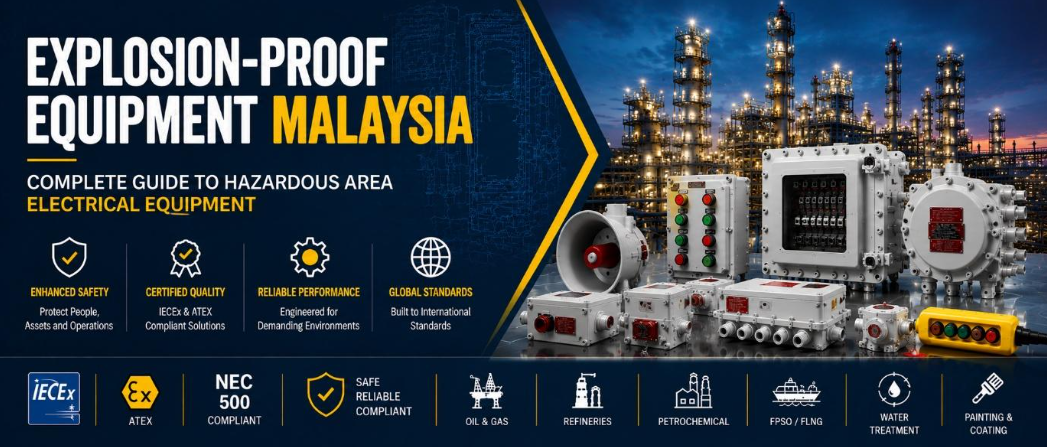
Selecting the correct explosion-proof equipment involves more than simply choosing a certified product. Factors such as hazardous area classification, gas or dust groups, temperature classes, environmental conditions, and applicable standards all influence equipment selection.
As a Malaysian provider of hazardous-area and explosion-proof solutions, ISEP works with customers across industries such as oil & gas, refinery, petrochemical, FPSO, FLNG, Pharmaceutical, water treatment, painting and coating, and industrial manufacturing. Whether you are planning a new installation, upgrading an existing facility, or reviewing hazardous-area compliance requirements, seeking professional advice early can help avoid costly specification errors later.
In the sections below, we explain the key concepts, equipment types, and considerations involved in selecting explosion-proof equipment for industrial applications.
Professional Compliance Guidance
Properly engineered explosion protection requires aligning international standard models with exact site risk assessments. ISEP assists plant managers, safety officers, and engineering teams across Malaysia in mapping and sourcing compliant hazardous-area setups.
What Is Explosion-Proof Equipment?
In industries where flammable gases, vapours, combustible dusts, or fibres may be present, ordinary electrical equipment can become a serious ignition source. A spark from a switch, motor, junction box, or control panel may be sufficient to ignite an explosive atmosphere, potentially resulting in fires, explosions, injuries, equipment damage, and costly downtime.
Explosion-proof equipment, also known as hazardous area equipment or Ex equipment, is specially designed to operate safely in potentially explosive environments. These products are engineered to prevent ignition, contain internal explosions, limit electrical energy, or isolate hazardous substances from potential ignition sources.
Explosion-proof equipment is commonly used throughout:
- Oil and gas facilities
- Refineries
- Petrochemical plants
- FPSOs and FLNGs
- Chemical processing plants
- Water treatment facilities
- Pharmaceutical manufacturing plants
- Food processing facilities
- Grain handling and storage operations
- Paint and coating facilities
Properly selected hazardous area equipment plays a critical role in protecting personnel, assets, operations, and the surrounding environment.
Why Is Explosion-Proof Equipment Important?
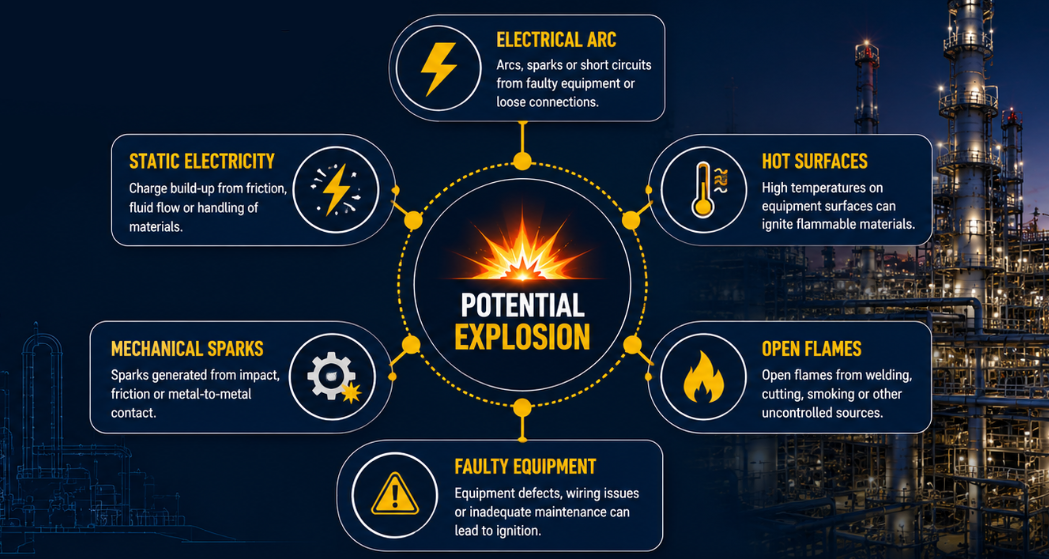
Preventing Fires and Explosions
An explosion occurs when three elements are present simultaneously:
- Fuel (flammable gas, vapour, mist, or dust)
- Oxygen
- Ignition source
While industrial facilities often cannot eliminate flammable substances entirely, they can reduce ignition risks through the use of properly certified explosion-proof equipment.
Modern explosion-proof equipment is designed to control or eliminate ignition sources (classified in European Standard EN 1127-1) such as:
- Hot surfaces
- Flames and Hot Gases
- Mechanically Generated Sparks
- Electrical apparatus (e.g. arcs)
- Stray Electrical Currents
- Static electricity
- Lightning
- Radio Frequency (RF) Electromagnetic Waves
- Optical Radiation (Fiber optic)
- Ionizing Radiation
- Ultrasonics
- Adiabatic Compression and Shock Waves (Rapid compression of gases)
- Exothermic Chemical Reactions (Self heating / Chemical Interactions that generate heat)
By preventing ignition, organizations significantly reduce the risk of catastrophic incidents.
Protecting Personnel and Assets
Industrial explosions can result in:
- Serious injuries or fatalities
- Damage to critical infrastructure
- Production downtime
- Environmental contamination
- Regulatory penalties
- Increased insurance costs
Investing in appropriate hazardous area equipment helps safeguard both people and business operations.
Meeting Regulatory Requirements
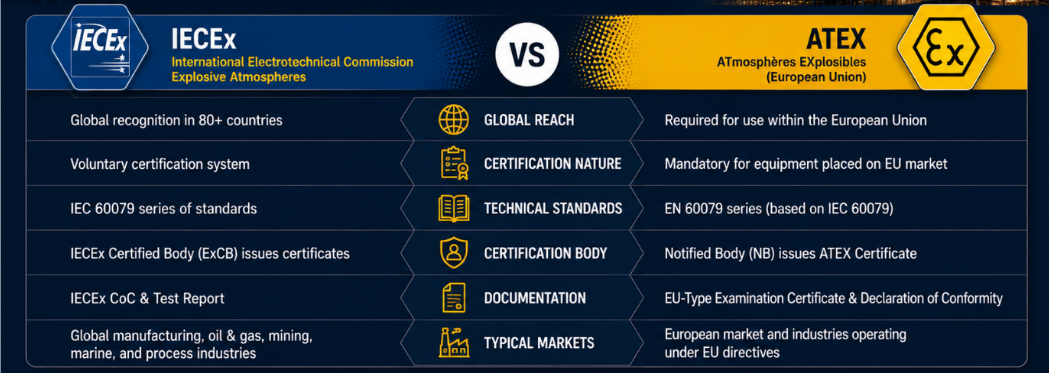
Many industries must comply with internationally recognized standards governing equipment used in hazardous environments. Common certification systems include:
- IECEx Certification
- ATEX Certification
- IEC 60079 Standards
- NEC Hazardous Location Requirements
Using equipment that is incorrectly specified or uncertified may expose businesses to significant safety and compliance risks.
Understanding Hazardous Area Classifications
Not all hazardous environments present the same level of risk. To ensure appropriate equipment selection, hazardous areas are classified according to the likelihood of explosive atmospheres being present.
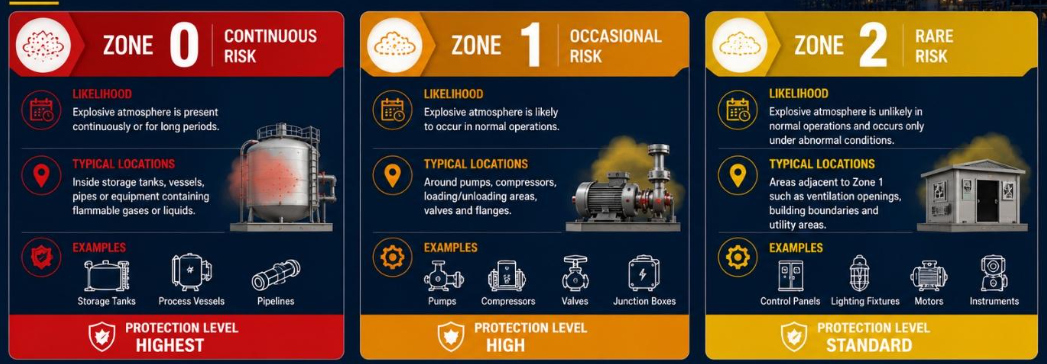
Explosive gas (Zone 0) or combustible dust (Zone 20) is present continuously, frequently, or for long periods.
Typical Locations:
Inside storage tanks, process vessels, pipelines, or enclosed process equipment containing flammable substances.
Explosive gas (Zone 1) or dust (Zone 21) is likely to occur during normal, day-to-day operations.
Typical Locations:
Around pumps, compressors, product loading/unloading stations, valves, flanges, and general processing sectors.
Explosive atmosphere is unlikely to occur in normal operation; if it does, it persists for a short period only.
Typical Locations:
Adjacent utility zones, surrounding process equipment with robust ventilation, building boundaries, and storage yards.
Equivalent dust risk codes apply similarly: Zone 20 for continuous, Zone 21 for normal operations, and Zone 22 for abnormal/brief operations.
How Does Explosion-Proof Equipment Work?
Several engineering design protection concepts are deployed in the construction of certified hazardous area electrical equipment to keep systems functional without introducing an ignition risk.
Table: Common Explosion Protection Concepts
| Protection Method | IEC Marking | Typical Zones | Typical Applications |
|---|---|---|---|
| Flameproof | Ex d | Zone 1, 2 | Motors, Junction Boxes |
| Increased Safety | Ex e | Zone 1, 2 | Terminal Boxes, Lighting |
| Intrinsic Safety | Ex i | Zone 0, 1, 2 | Sensors, Instruments |
| Pressurization | Ex p | Zone 1, 2 | HMIs, Control Panels |
| Dust Protection | Ex t | Zone 20, 21, 22 | Grain & Powder Silos |
Flameproof Enclosures (Ex d)
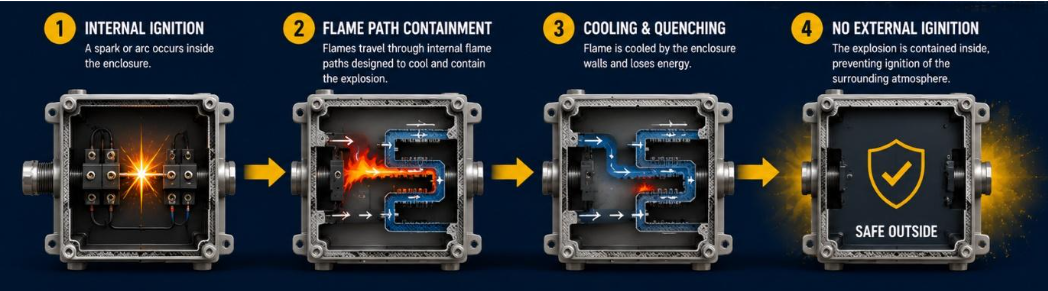
Flameproof enclosures are designed to contain an internal explosion without allowing flames or hot gases to escape and ignite the surrounding explosive atmosphere. These enclosures are heavily constructed and commonly used for junction boxes, switchgear, motor starters, and control panels. Ex d remains one of the most widely used protection methods in upstream and downstream oil and gas facilities.
Increased Safety (Ex e)
Ex e equipment prevents ignition by implementing increased safety features, eliminating sparks, electrical arcs, and excessive temperatures during normal operating conditions. This protection method is frequently selected for terminal boxes, lighting systems, and heavy industrial enclosures.
Intrinsic Safety (Ex i)
Intrinsic safety limits the electrical and thermal energy of a system to levels below what is capable of igniting explosive atmospheres. Primarily utilized for low-voltage/current applications like sensors, pressure transmitters, instrumentation, and process control systems. Ex i is widely accepted for Zone 0 and Zone 1 instrumentation lines.
Pressurization (Ex p)
Pressurized systems maintain a continuous positive pressure of clean air or inert gas inside an enclosure, physically preventing hazardous gas or dust from entering the system. This method is highly effective for industrial computers, HMIs, large control panels, and complete analyzer shelters.
Common Types of Explosion-Proof Equipment
Modern industrial hazardous area installations depend on multiple categories of explosion-proof equipment working in coordination as a comprehensive, plant-wide safety solution.
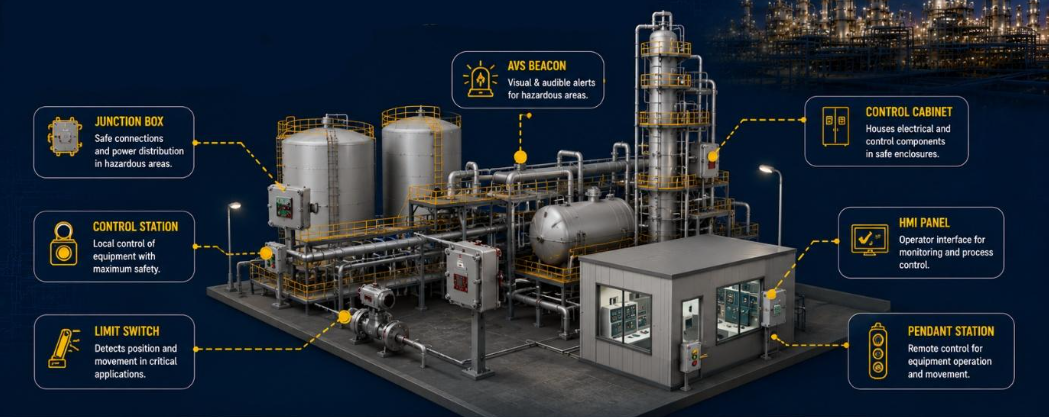
Junction Boxes
Provide protected connection points for electrical, instrumentation, power distribution, and communication networks.
Control Stations
Enable safe local operation with push buttons, emergency stops, selector switches, and signaling indicators.
Control & Signalling Units
Deliver crucial real-time feedback regarding process state, alarm indication, and device monitoring.
Audible Visual Signalling (AVS)
Industrial sirens, warning horns, strobe lights, and flashing beacons to communicate plant emergencies.
Control Cabinets & Enclosures
Protect core ICSS, DCS, SIS, FGS, turbine/compressor control boards, and PLCs from hazard ingress.
Stainless Steel Junction Boxes
CTB IV stainless steel systems designed for optimal corrosion resistance on marine, food, and chemical sites.
Limit Switches
Track the position and mechanical movement of critical process equipment, valves, and conveyor corridors.
Pendant Stations
Allow operations teams to safely direct hoist, crane, and materials-handling maneuvers in hazardous areas.
HMIs & Operator Displays
Fully certified, high-visibility interactive visual screens facilitating secure, local SCADA control.
Industries That Depend on Explosion-Proof Equipment
Oil and Gas
Explosion-proof equipment is absolutely essential across offshore drilling platforms, floating production units (FPSOs and FLNGs), onshore refineries, gas processing facilities, and bulk fuel storage distribution terminals.
Petrochemical and Chemical Processing
Chemical facilities handle volatile organic compounds, solvents, alcohols, and high-pressure hydrocarbons daily, requiring rigorous hazardous area planning.
Water Treatment Plants
Methane and dangerous biogas compounds generated during wastewater fermentation and anaerobic sludge treatment create hazardous Zone 1 and Zone 2 environments requiring certified Ex hardware.
Pharmaceutical Manufacturing
Many critical active ingredient synthesis and processing procedures involve volatile solvent distillation, spray drying, and organic gas streams, making hazardous area protection a paramount design criterion.
Food Processing and Agriculture
Suspended organic dusts can trigger violent combustible dust explosions. Grain elevators, flour mills, sugar refineries, starch production units, and feed mills require specialized dust ignition protection (Ex t).
How to Select the Right Explosion-Proof Equipment
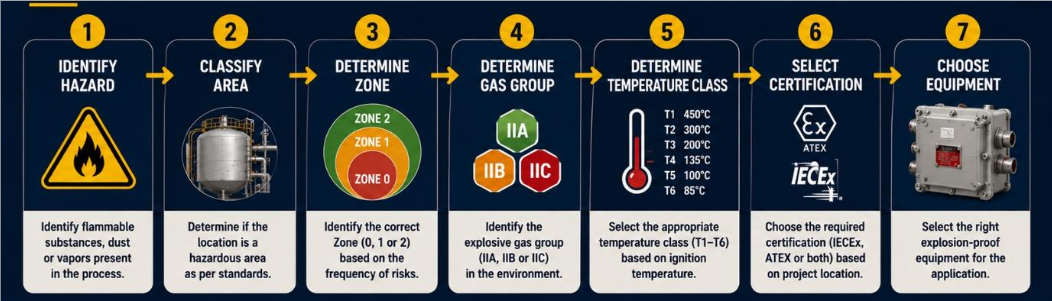
Selecting the appropriate explosion-proof setup requires analyzing multiple risk vectors and environmental parameters:
Confirming if the exact equipment location is designated as Zone 0, 1, or 2 (Gases) or Zone 20, 21, or 22 (Dusts).
Matching the correct standard Group index (Group I for mining, Group IIA, IIB, IIC for gases, Group III for dusts) with the hazards present.
Ensuring maximum outer surface temperatures (T1 to T6) remain below the auto-ignition threshold of the surrounding gas or dust mixtures.
Accounting for chemical corrosion, salt spray, extreme humidity, high-pressure washdowns, UV exposure, and ingress risks (IP ratings).
Because improper specification can lead to system failures, safety risks, and regulatory non-compliance, many operations team leaders engage certified hazardous area experts like ISEP early in the engineering and purchasing lifecycle.
Looking for Explosion-Proof Equipment in Malaysia?
Every hazardous area application is unique. The most suitable solution depends on factors such as hazardous area classification, environmental conditions, certification requirements, and operational objectives.
ISEP provides technical support and explosion-proof solutions for a wide range of industrial applications, including:
- Explosion-proof junction boxes
- Control stations
- Audible visual signalling devices
- Control and signalling units
- CTB III stainless steel enclosures
- Control cabinets
- Limit switches
- Pendant stations
- Operator displays
- Hazardous area electrical equipment
By combining engineering expertise with internationally recognized standards such as IECEx, ATEX, and NEC requirements, ISEP helps organizations select solutions that support safe, compliant, and reliable operations.
Conclusion
Explosion-proof equipment plays a vital role in protecting industrial facilities operating in potentially explosive environments. From junction boxes and control stations to signalling devices, stainless steel enclosures, control cabinets, and operator displays, each component contributes to a comprehensive hazardous area safety strategy.
How Flameproof (Ex d) Containment Works
As industries continue to adopt automation, digitalization, and advanced process control technologies, selecting the right hazardous area equipment has become increasingly important. Understanding hazardous area classifications, certification requirements, and protection concepts can help organizations improve safety, maintain compliance, and reduce operational risks.
Whether you are planning a new project, upgrading existing facilities, or reviewing hazardous-area compliance, working with experienced explosion-proof equipment specialists can help ensure that the right solutions are selected for the application.
Connect with ISEP Malaysia
Speak directly with an application engineer today to resolve your enclosure specs, IECEx certification requirements, or layout queries.
Frequently Asked Questions (FAQ)
Explore technical answers to the most common queries regarding hazardous area classifications, protection methods, and standards.
Explosion-proof equipment refers to electrical or mechanical devices specifically designed to operate safely in hazardous areas where flammable gases, vapours, mists, or combustible dusts may be present. These products are engineered to prevent ignition, contain internal explosions, or isolate ignition sources from the surrounding atmosphere, helping reduce the risk of fires and explosions in industrial facilities.
Explosion-proof equipment is commonly used in industries such as oil and gas, petrochemical processing, refineries, FPSOs, FLNG facilities, chemical manufacturing, pharmaceutical plants, water treatment facilities, food processing plants, grain storage facilities, and paint manufacturing operations where potentially explosive atmospheres may occur.
The terms "explosion-proof" and "flameproof" are often used interchangeably, but they originate from different standards. "Explosion-proof" is commonly used in North America, while "flameproof" (Ex d) is used under IECEx and ATEX standards. Both concepts involve equipment designed to contain an internal explosion and prevent ignition of the surrounding hazardous atmosphere.
Hazardous area equipment refers to electrical, electronic, or mechanical equipment certified for use in environments where flammable gases, vapours, or combustible dusts may be present. Examples include explosion-proof junction boxes, control stations, signalling devices, lighting systems, enclosures, and instrumentation designed to meet IECEx or ATEX requirements.
IECEx is an international certification system based on IEC 60079 standards and is widely recognized around the world. ATEX is the European Union regulatory framework governing equipment used in explosive atmospheres. While both systems share many technical requirements, ATEX is mandatory within the European Economic Area, whereas IECEx facilitates global acceptance of certified equipment.
Zone classifications indicate the likelihood of an explosive atmosphere being present.
Zone 0: Explosive atmosphere is present continuously or for long periods.
Zone 1: Explosive atmosphere is likely to occur during normal operations.
Zone 2: Explosive atmosphere is unlikely during normal operations and only occurs under abnormal conditions.
The higher the risk, the more stringent the equipment requirements.
Selecting the correct explosion-proof equipment requires consideration of several factors, including hazardous area classification, gas or dust group, temperature class, environmental conditions, certification requirements, and operational needs. Consulting a hazardous-area specialist can help ensure the selected equipment meets both safety and compliance requirements.
An explosion-proof junction box is a certified enclosure used to safely connect and protect electrical wiring in hazardous environments. These junction boxes are designed to prevent internal sparks or explosions from igniting the surrounding atmosphere and are commonly used in oil and gas, petrochemical, and industrial facilities.
An explosion-proof control station allows operators to safely start, stop, monitor, or control equipment in hazardous locations. Typical components include push buttons, selector switches, emergency stop buttons, and indicator lights housed within a certified enclosure designed for hazardous environments.
Explosion-proof enclosures protect electrical components from hazardous atmospheres while preventing internal ignition sources from causing external explosions. They are commonly used to house control panels, PLCs, instrumentation systems, communication equipment, and motor control systems in hazardous locations.
Yes. Combustible dusts such as flour, sugar, grain dust, starch, cocoa powder, and certain metal dusts can create explosive atmospheres when suspended in air. Dust explosions can be extremely destructive and are a significant safety concern in food processing, agriculture, pharmaceutical manufacturing, and industrial production facilities.
Intrinsic safety (Ex i) is a protection method that limits electrical and thermal energy within a circuit to levels below those required to ignite an explosive atmosphere. Intrinsically safe systems are widely used for sensors, transmitters, instrumentation, and process control equipment, particularly in Zone 0 and Zone 1 environments.
IECEx-certified equipment is commonly required in industries such as oil and gas, petrochemicals, refining, offshore platforms, chemical processing, pharmaceuticals, mining, water treatment, food manufacturing, and any industrial facility operating within hazardous environments where explosive atmospheres may occur.
Explosion-proof equipment should be inspected regularly according to applicable standards, site procedures, and risk assessments. Inspection programs typically verify enclosure integrity, cable entries, grounding systems, flamepaths, corrosion levels, and overall compliance to ensure equipment continues to operate safely throughout its service life.
Businesses requiring explosion-proof equipment in Malaysia should work with experienced hazardous-area solution providers that understand IECEx, ATEX, and hazardous area classification requirements. Reputable suppliers can provide technical support, equipment selection assistance, and certified solutions such as junction boxes, control stations, signalling devices, enclosures, control cabinets, and other hazardous area products.
Zone 1 equipment is designed for areas where explosive atmospheres are likely to occur during normal operations, while Zone 2 equipment is intended for areas where explosive atmospheres occur only infrequently and for short periods. Because Zone 1 environments present a higher level of risk, the equipment typically requires a higher level of protection and certification.
No. Standard electrical equipment is generally not designed to prevent ignition in hazardous environments and may create sparks, arcs, or hot surfaces capable of igniting flammable substances. Only properly certified hazardous-area equipment should be installed in classified locations.