
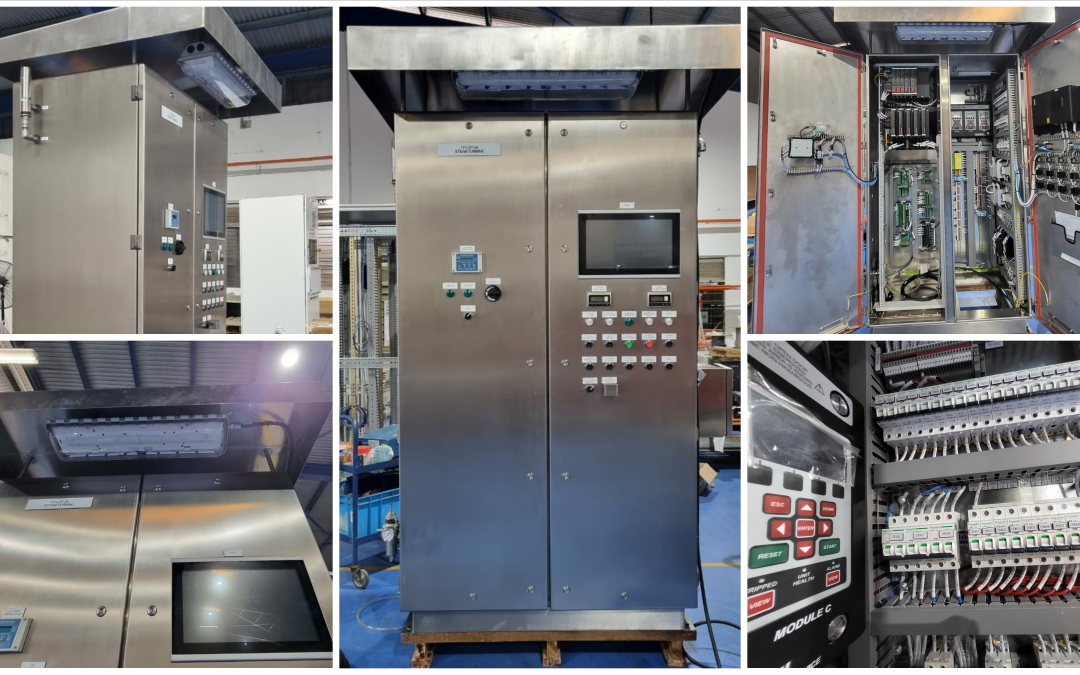

IEC60079-2 Equipment Protection by Pressurized enclosure “p”
- Contain specific requirements for the construction and testing of electrical apparatus with pressurized enclosures, of type of protection “p”, intended for use in explosive gas atmosphere. It specifies requirement for pressurized enclosures containing a limited release of a flammable substance
Application :
- Instrument Control Panel
- Printer
- Large Display
IEC 60079-13 Equipment protection by Pressurized room “p” and artificially ventilated room “v”
Contain specific requirements for the design, construction, assessment & testing and marking of rooms protected by pressurization in :
- A room located in a Group II(gas) or Group III(dust) hazardous area that does not include an internal source of a flammable substances,
- A room located in a Group II(gas) or Group III(dust) hazardous area that includes an internal source of a flammable substance.
- A room located in a non-hazardous area that includes an internal source of a flammable substance.
Principle & Advantage of Purge – Pressurization
Principle of Purge & Pressurization
Purge and pressurization is a protection method that uses compressed air or inert gas to eliminate and prevent hazardous substances, like gas, dust, or a combination of the two, from harming electronic equipment housed in an enclosure
Advantage
Purging is a widely accepted protection concept for explosion protection. It is accepted world-wide (using European Standards, NFPA or IEC Standards) because it was straight-forward
Explosion protection is achieved by keeping the potentially explosive atmosphere away from any source of ignition (thermal or electrical).
The potentially ignition capable apparatus is mounted inside an enclosure, the enclosure is then pressurized to a positive pressure relative to the atmospheric pressure (a positive pressure of 0.5mbar is all that is required).
Type of Pressurization
IEC 60079-2 Equipment Protection by Pressurized enclosure “p”
Ex pzc – For Zone 2 (symbol c is represent Zone 2)
Type pzc :
Pressurization that reduces the EPL within the pressurized room/enclosure from Gc (Zone 2) to non-hazardous by maintaining a positive pressure differential between enclosure and atmosphere.

Typical application
- Electrical panels
- Analyzer
- Instrument Control Enclosure
- Printer
- HMI
Design requirement
- Purge Control Unit –initial purging prior to system energize
- Alarm indication on loss of pressure but system remains energized
- Constant flow or leak compensation using inert gas or clean air
- Must be tested and certified by manufacturer/ authorized third party laboraties
Ex pxb – For Zone 1 (symbol b is represent Zone 1)
Type pxb :
Pressurization that reduces the EPL within the pressurized room/enclosure from Gb (Zone 1) to non-hazardous by maintaining a positive pressure differential between room/enclosure and atmosphere.

Typical application
- Electrical panels
- Analyzer
- Instrument Control Enclosure
- Printer
- HMI
Design requirement
- Purge Control Unit –initial purging prior to system energize
- Alarm indication on loss of pressure but main power will be cutoff, and system shall be shutdown.
- Constant flow or leak compensation using inert gas or clean air
- Must be tested and certified by authorized third party laboraties
Ex pyb – For Zone 1 (symbol b is represent Zone 1)
Type pyb :
Pressurization that reduces the EPL within the pressurized room/enclosure from Gb (Zone 1) to Gc (Zone 2) by maintaining a positive pressure differential between enclosure and atmosphere.

Typical application
- Motor
- Switching Equipment
- ICSS/SIS/FGS Systems
Design requirement
- Purge Control Unit – automatic initial purging prior to system energize
- Alarm indication on loss of pressure but system remains energized
- Constant flow or leak compensation using inert gas or clean air
- Must be tested and certified by authorized third party laboraties
Purge & Pressurize Protection Method
- Static pressurization:
No supply of protective gas (air or inert gas, e.g. nitrogen) in the explosive area. (During Operation).
Static pressurization relies on the enclosure being pressurized with an inert gas and having a sealed enclosure to maintain the pressurization. The protective gas shall be inert.
- Internal sources of release of flammable substances are not permitted.
- The pressurized enclosure shall be filled with inert gas in a non-hazardous area using the procedure specified by the manufacturer
- Two automatic safety devices shall be provided to operate when the overpressure falls below the minimum value specified by the manufacturer.
- Pressurization with leakage compensation:
Permenant flow of inert gas into the enclose to make sure that all losses based on leackage are compensated
- These systems consume less compressed air which results in lower operating costs. The benefit of a high initial purge flow rate also means that even large enclosures can be purged in a reasonable time.
- On the downside, Leakage Compensation equipment is slightly more complex and therefore has a higher upfront cost. Further the cost savings on less compressed air can be eliminated if the enclosure that is being used has excessive leakage.
- Understanding the differences between the systems is important when making the initial purchase and corresponding effect it will have on your operations.
- Pressurization with continuous circulation of inert gas :
- Continuous Flow systems are normally used with smaller enclosures having a volume of less than 17 cubic feet (0.4 m) or with enclosures that are infrequently placed into service.
- Advantages of these systems include the simplicity of their operation and lack of any action (automatic or manual) between purge and pressurization phases. The simplicity of Continuous Flow products also leads to lower upfront costs.
- However, these systems constantly consume compressed air resulting in higher running or operating costs. They also typically have a lower flow rate that can result in unacceptably high purge times on larger enclosures before equipment can be energized or used.