
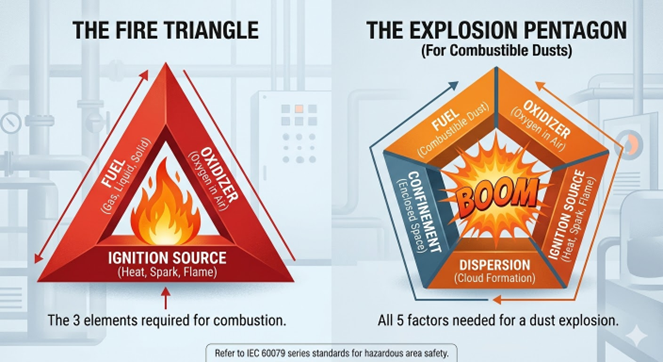
In high-risk industrial environments, strict adherence to international safety standards separates controlled operations from catastrophic incidents. Understanding how a fire can escalate into an explosion is crucial for IEC 60079 compliance and modern process safety management.
Distinguishing Between Smoldering Fires and Atmospheric Explosions
Safety inductions often start with the Fire Triangle, but “Ex” (explosive) atmospheres require a deeper understanding. A fire can escalate to an explosion not just through intensity, but due to physics—dispersion and confined spaces play a critical role.
The Fundamental Fire Triangle
At its most basic level, a fire is a chemical chain reaction requiring three specific components to be present simultaneously:
. Fuel: This includes any substance capable of ignition, including from hydrocarbon gases and volatile liquids to solid combustible fibers.
. Oxidizer: In most industrial settings, this is the oxygen present in the ambient atmosphere, though it can include other chemical oxidizing agents.
. Ignition Source: This represents the thermal energy required to initiate combustion, such as an electrical spark, a hot surface, or an open flame.
The Evolution to the Explosion Pentagon
When dealing with fine particulates or pressurized vapors, the triangle expands into the Explosion Pentagon. This model accounts for the two critical factors that escalate a fire into a high-pressure blast event:
. Dispersion: For an explosion to occur, the fuel cannot remain in a static pile or a contained liquid pool, it must be suspended in the air as a dust cloud or a vapor mist at a concentration within its explosive limits.
. Confinement: This refers to the physical boundaries such as a vessel, duct, or poorly ventilated room that prevent the rapid expansion of heated gases. When these gases are trapped, pressure builds exponentially until the structural integrity of the enclosure fails.
Technical Insight: Using IEC 60079-0 principles, facilities can analyze fuel “Material Characteristics” to pinpoint when a fire hazard becomes an explosion risk, considering dispersion and confinement.
The IEC 60079 Compliance Framework
The IEC 60079 standards offer a multi-layered framework to address all sides of the Explosion Pentagon. Following these benchmarks ensures that if one safety layer fails, others prevent a local ignition from turning into a facility-wide disaster.
Mapping the Hazard (IEC 60079-10-1 & 10-2)
The first step in any compliance strategy is the scientific classification of the environment.
. IEC 60079-10-1 (Gases and Vapors) and IEC 60079-10-2 (Combustible Dusts) provide the methodologies for identifying “Zones.”
. These standards focus on the Fuel and Dispersion sides of the pentagon, calculating how likely it is for a flammable atmosphere to exist during normal or abnormal operations. Correct area classification ensures that appropriate protective measures are implemented in locations with the highest risk of cloud formation.
Preventing the Spark (IEC 60079-14)
Once the hazardous zones are defined, IEC 60079-14 governs the selection, design, and installation of electrical systems to eliminate the Ignition Source.
. Protection methods like Intrinsic Safety (Ex i) limit the available energy to a level below the Minimum Ignition Energy (MIE) of the fuel.
. Alternatively, Flameproof (Ex d) address the Confinement factor by allowing an internal explosion to occur while ensuring the flame path is cooled sufficiently so that it cannot ignite the external atmosphere.
Sustaining Safety Through Life-Cycle Inspections (IEC 60079-17)
The most advanced “Ex” equipment is only effective if its protective features remain uncompromised. IEC 60079-17 establishes the requirements for the ongoing inspection and maintenance of these systems.
. This standard ensures that environmental factors like corrosion, mechanical vibration, or unauthorized equipment modifications do not accidentally complete a side of the Explosion Pentagon.
. Regular inspections verify that the “Confinement” seals are tight and that “Increased Safety” (Ex e) components are not operating at temperatures that could serve as a heat-based ignition source